Showing posts with label book burning. Show all posts
Friday, February 24, 2012
How to dispose of the Quran correctly
...It is important to give a Quran a proper burial, says Omid Safi, professor of Islamic studies at the University of North Carolina and author of “Memories of Muhammad.” Any text containing the name of God is sacred in Islam. God is revealed through scripture, and anything associated with writing it has a religious significance, Mr. Safi says.
One could literally bury the Quran, ideally in a place with little foot traffic. Another option is to put the book in a flowing body of water, either letting it sink or be carried away. Regardless of the method, treating the book’s destruction with respect is paramount. Safi likens it to a poor man’s funeral, where the book might be wrapped in a shroud before being placed in the ground and mourned.
Burning the Quran, however, is also an accepted practice.
“People often ask, ‘if it’s OK for Muslims to burn the Quran, then why isn’t it OK for the US military to do it?’” Safi says. “That’s where the question of symbolism is important.”
Some say erasing the names of God and his messengers prior to burning the Quran makes it acceptable, but Safi says it’s even simpler than that. It comes down to context: Burning the text in a dumpster with trash on a US military base feels less respectful than treating the disposal with reverence in a burial or sacred burning.
Safi finds one analogy particularly helpful: The Quran is to Islam as Jesus is to Christianity. “In an Islamic universe ... the word becomes not a person, but a book,” he says. “For a Muslim to see the Quran burnt not as a way of burial, it would look and feel like someone burning Jesus, or a crucifix.”
But contextualizing today’s protests goes beyond simple reverence for the Quran, Safi says. “Bagram airbase is one of the central places of US military presence in Afghanistan ... [and] between 600 and 700 Afghans have been detained or are being detained there for years and years.”
Safi says this isn’t so much a theological debate on how to dispose of the Quran properly, but a charged conversation around a military force “that’s being looked at as an occupying force ... [A]n unlawful, violent force.” [1]
Burning books in Afghanistan
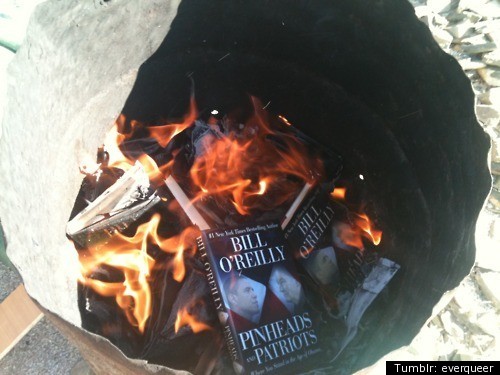
Afghanistan is a desert war zone. The troops burn their trash, including books. O'Reilly sent copies of his book to Afghanistan. Not enough soldiers wanted them, so they were burned.[1]
A group of evangelical soldiers tried to evangelize the Afghans around the base with Bibles mailed to them from an US church.
.
Central Command General Order No. 1 specifically forbids “proselytizing of any faith, religion or practice.”[2]Those Bibles were burned.
They confiscated Qurans from prisoners. They then sacrilegiously destroyed the books. This is different than what was done with the Evangelical Bibles. The purpose of the Bibles was not personal worship. Also the troops were not prisoners. Prisoners are under different human rights protections. If these Afghan detainees are covered by the Geneva Conventions, this is the applicable portion.
Article 34
Prisoners of war shall enjoy complete latitude in the exercise of their religious duties, including attendance at the service of their faith, on condition that they comply with the disciplinary routine prescribed by the military authorities.
Adequate premises shall be provided where religious services may be held. [3]
Chaplains who fall into the hands of the enemy Power and who remain or are retained with a view to assisting prisoners of war, shall be allowed to minister to them and to exercise freely their ministry amongst prisoners of war of the same religion, in accordance with their religious conscience. They shall be allocated among the various camps and labour detachments containing prisoners of war belonging to the same forces, speaking the same language or practising the same religion. They shall enjoy the necessary facilities, including the means of transport provided for in Article 33, for visiting the prisoners of war outside their camp. They shall be free to correspond, subject to censorship, on matters concerning their religious duties with the ecclesiastical authorities in the country of detention and with international religious organizations. Letters and cards which they may send for this purpose shall be in addition to the quota provided for in Article 71. [4]
Article 36
Prisoners of war who are ministers of religion, without having officiated as chaplains to their own forces, shall be at liberty, whatever their denomination, to minister freely to the members of their community. For this purpose, they shall receive the same treatment as the chaplains retained by the Detaining Power. They shall not be obliged to do any other work. [5]
When prisoners of war have not the assistance of a retained chaplain or of a prisoner of war minister of their faith, a minister belonging to the prisoners' or a similar denomination, or in his absence a qualified layman, if such a course is feasible from a confessional point of view, shall be appointed, at the request of the prisoners concerned, to fill this office. This appointment, subject to the approval of the Detaining Power, shall take place with the agreement of the community of prisoners concerned and, wherever necessary, with the approval of the local religious authorities of the same faith. The person thus appointed shall comply with all regulations established by the Detaining Power in the interests of discipline and military security. [6]
Article 38
Prisoners shall have opportunities for taking physical exercise, including sports and games, and for being out of doors. Sufficient open spaces shall be provided for this purpose in all camps. [7]
Prisoners are given "complete latitude", I am not certain if you can confiscate their Qurans. Still I do not know. I am neither a soldier or a lawyer.
However, it is also important to note that if the Qurans were garbage, they were to be burned like all garbage. The military burns Bibles and I am sure they burn other religious texts. I do not know how the military was supposed to dispose of the books. I am sure we'll find out.
WSJ:Protests Against Quran-Burning Roil Afghanistan
KABUL—Afghanistan's government and religious leaders failed to mollify angry worshippers Friday, as a new wave of protests against the burning of Qurans at a U.S. military base swept across the country.
While most of Friday's demonstrations ended peacefully, several degenerated into turbulent clashes between Afghan police and marchers chanting anti-American slogans.
| Afghan demonstrators shout anti-US slogans as they carry a wounded man during a protest in Herat on Friday |
The deadliest such clash took place in Herat, a normally tranquil city in western Afghanistan, where demonstrators tried to march toward the U.S. consulate compound. At least six people were killed and 65 injured during confrontations with the Afghan security forces protecting the building, according to Mahiddin Noori, a spokesman for the Herat governor. The protesters failed to reach the consulate.
All in all, at least 20 people have been killed, including two U.S. soldiers, in four days of violence that erupted after U.S.-led coalition forces at the Bagram Airfield tried to burn a truckload of Islamic literature, including copies of the Quran, Islam's holy book.
Afghan workers said they rescued the books from the incinerator and then smuggled them off the base to show to local leaders. That ignited an escalating series of violent protests that have targeted coalition military bases, Afghan government buildings, United Nations offices and other symbols of Western presence in the country.
The U.S. has tried to mute the anger by launching an investigation and repeatedly apologizing for the occurrence. On Thursday, President Barack Obama expressed his "deep regret" to President Hamid Karzai in a personal letter to the Afghan president in which he vowed to hold to account those responsible for the Bagram incident.
U.S. military officials have said the books were set aside for destruction because Afghan detainees at the Parwan military detention center at Bagram were using them to trade messages and share extremist writing. But it remains unclear why the soldiers decided to burn copies of the Quran—a particularly incendiary affront to Muslims who view the book as the sacred word of God as relayed to the Prophet Muhammad.
On the eve of Friday's protests, Mr. Karzai and the country's religious leaders tried to limit the violence by urging people to express their anger peacefully. Preachers in mosques across Kabul tried to reinforce that message during Friday's weekly prayers.
"Those who burned the Quran are illiterate," thundered a preacher in Kabul's Khaled Ibn Walid mosque. "They don't know what religion is, but for us the solution is not violent demonstrations that kill our own people."
Similar messages in mosques across Kabul prevented chaotic anti-American marches from sweeping the city center. But elsewhere in the country and in the outskirts of Kabul, Afghan police trying to block the marchers from converging on Western compounds clashed with protesters.
In Herat, shooting erupted as hundreds of protesters, some of them armed, tried to march toward the U.S. consulate, local officials said. Outside the city, demonstrators burned two police stations, Mr. Noori said.
As worshippers gathered for Friday prayers, U.S. Marine Gen. John Allen, commander of the International Security Assistance Force in Afghanistan, urged Afghans to be patient and wait for the results of the investigation.
"Working together with the Afghan leadership is the only way for us to correct this major error and ensure that it never happens again," he said in a statement.
On Thursday night, Gen. Allen, accompanied by the Afghan Army Chief of Staff Gen. Sher Karimi, flew to a joint U.S.-Afghan base in eastern Afghanistan where an Afghan soldier opened fire on American forces during a protest earlier that day, killing two.
"Now is not the time for revenge," Gen. Allen told U.S. soldiers gathered at the small base in Nangarhar province. "Now is the time to look deep inside your souls and remember your mission. Now is how we show the Afghan people that, as bad as that action was at Bagram, it was unintentional, and American's and ISAF soldiers do not stand for this." [1]
Also this is from ABC on the timing of the apology.
The White House says the president’s apology was conveyed before the U.S. troops were killed today.
Furthermore, the administration notes that the apology, which was included in a lengthy three-page letter from Obama to Karzai on a range of issues, is not unprecedented. In 2008, President Bush apologized to Iraq’s prime minister for an American sniper’s shooting of a Koran.[2]
Subscribe to:
Posts (Atom)