Showing posts with label carl kerby. Show all posts

Monday, May 12, 2014

He looked just like us

This weekend, I was flipping through Ken and Mally Ham's A is for Adam: The Gospel from Genesis (Spiral Bound).  Now I make no bones on this blog about the fact that I am not a "biblical creationist", so you can imagine that I did not agree with a lot of the book.  Still one thing struck me.  I know that it is a children's book, but Adam is depicted as a white man with a beard and shoulder length hair.  Then the book tells the reader that, "He wasn't a monkey, he looked just like us."

I know that this is a children's book and I do not want to make the same mistake that some "biblical creationists" make when they take a children's book and try to make a mountain out of the author's attempt to simplify a subject (see Carl Kerby).  I do not wish to argue whether man is a Homo sapien, hominid, or primate.  What struck me was the phrase "he looked just like us".  I discussed this briefly in a post, Contradictory Messages.

Homo erectus
Like Ray, the Hams believe that both individuals in this picture are fully human and I suspect they believe that both could have been what Adam looked like.  It seems a little misleading for the authors to depict Adam as a Homo sapien who "looked just like us" when they also believe that he did not have to "look just like us."

Monday, February 10, 2014

Are Crocodilians one thing? Part II

As a general rule, I try to present someone else's position as accurately as possible.  Therefore, I read a lot of creationist materials.  In January, Tom Hennigan posted two more papers on estimating "kinds": An Initial Estimate toward Identifying and Numbering the Ark Turtle and Crocodile Kinds and An Initial Estimate Toward Identifying and Numbering Amphibian Kinds within the Orders Caudata and Gymnophiona.

I have enjoyed reading these papers and they have actually helped me freshen up on my taxonomy.  I have written about these types of papers elsewhere and do not wish to rehash old posts.  You can read The Kind of argument we are having and Avian Kinds for more details.

I just wanted to call attention to two things. A couple of years ago, I wrote a series of blog posts about Carl Kerby in my view misrepresenting a phylogenetic chart. In Are Crocodilians one thing?, I dealt with Kerby's claim that Crocodilians, now called Crocodyliformes, are "one thing."  Below is all the diversity that Kerby allows in this kind.  (Image drawn by Darren Naish and can be found on his blog)


Hennigan chooses to deal only with Crocodylia and this is probably due to AiG's hesitance to speak to fossil kinds in these initial papers.  While Lightner tends to accept broad genetic relationships and create large kinds, Hennigan tends to be more narrow.  While he admits that all Crocodylia may have had a common ancestor, "the kind is delineated at the family level because of their strong cognita, interspecific hybridization reported within (but not across) some families, and the need for more understanding of what the molecular data mean."

In his paper on salamanders, he does the same thing.
Family Plethodontidae is the largest salamander group with 27 genera and 431 species having an average total length of 10 cm...The family is quite diverse, for example, some can ballistically project their tongue to catch prey while others have web feet. Until further research sheds light on why they are so diverse, I default the kind to genus. It is probable that many will eventually be lumped into larger taxa in the future.
 Remember, the diversity is a problem for the "biblical creationist", because they only have the 4000 years since Noah's Ark to account for the diversity.  While Lightner is more willing to appeal to supernatural mechanisms, Hennigan does not wish to go down that route, at least not initially.

Friday, October 11, 2013

What are the 60 dinosaur kinds?


I keep asking about these 60 or 50 dinosaur kinds.  This was one of the main questions that led me to reject Young Earth Creationism.  What are the orders of mammalia? Google it.  You will find a debate over whether there are between 19-29 orders.  Start looking for Dinosaur kinds.  What you will not find is a debate among creationist about 60 or 50 kinds of dinosaurs.  What you will find is an assertion of it's validity and one or two examples of a Dinosaur kind.  The most common example of a dinosaur kind is ceratopsia.
The sub-order ceratopsia includes both bipeds and quadrupeds.  This transition from semi-bipedal to quadrupedal is accepted by both evolutionists and creationists.  However if we accept that the sub-order ceratopsia is one dinosaur kind, how can there be half a hundred dinosaur kinds?  That level of diversity would seem to imply that Oviraptor and Tyrannosaurus Rex were the same kind or for comparison that hyenas and cats are the same kind.  That is just what Carl Kerby seems to do in his blog post, Phylogenic Charts
He gives fourteen different sub-orders and clades of dinosaurs that he terms as "one thing, stayed one thing, and never changed from, or into, anything else."
  • j Deinonychosaurs. 
  • h Oviraptorosaurs. 
  • m Carnosaurs and Coelurosaurs. 
  • n Segnosaurs. 
  • o Prosauropods.
  • p Sauropods. 
  • q Fabrosaurids. 
  • r Scelidosaurs. 
  • s Stegosaurs. 
  • t Ankylosaurs. 
  • u Ornithopods. 
  • v Heterodontosaurids. 
  • w Ceratopsians. 
  • x Pachycephalosaurs.
Creation.com shrinks the groups even further in their Dinosaur Fairy Tales with only eight kinds (in fairness they leave out Heterodontosaurids, Scelidosaurs, and Fabrosaurids).

  • Ceratopsians
  • Pachycephalosaurs
  • Ornithopods
  • Stegosaurs
  • Ankylosaurs
  • Theropods (Segnosaurs, Deinonychosaurs, Oviraptorosaurs, Carnosaurs, and Coelurosaurs)
  • Prosauropods
  • Sauropods
The point is that if ceraptosia is a dinosaur kind, what are the other 49?  How can there be another 49 let alone another 59?  More importantly where is the list of 50 dinosaur kinds?  In trying to find this list, I was amazed at how much evolution had been accepted by creationists as microevolution.  Also, I was amazed at how often creationists made the claim of tens of dinosaur kinds, but never backed it up.  What kind of worldview does that?  Not a worldview that I could continue to hold.  I did not only abandon young earth creationism, because of this, but it was a start.  


Thursday, September 27, 2012

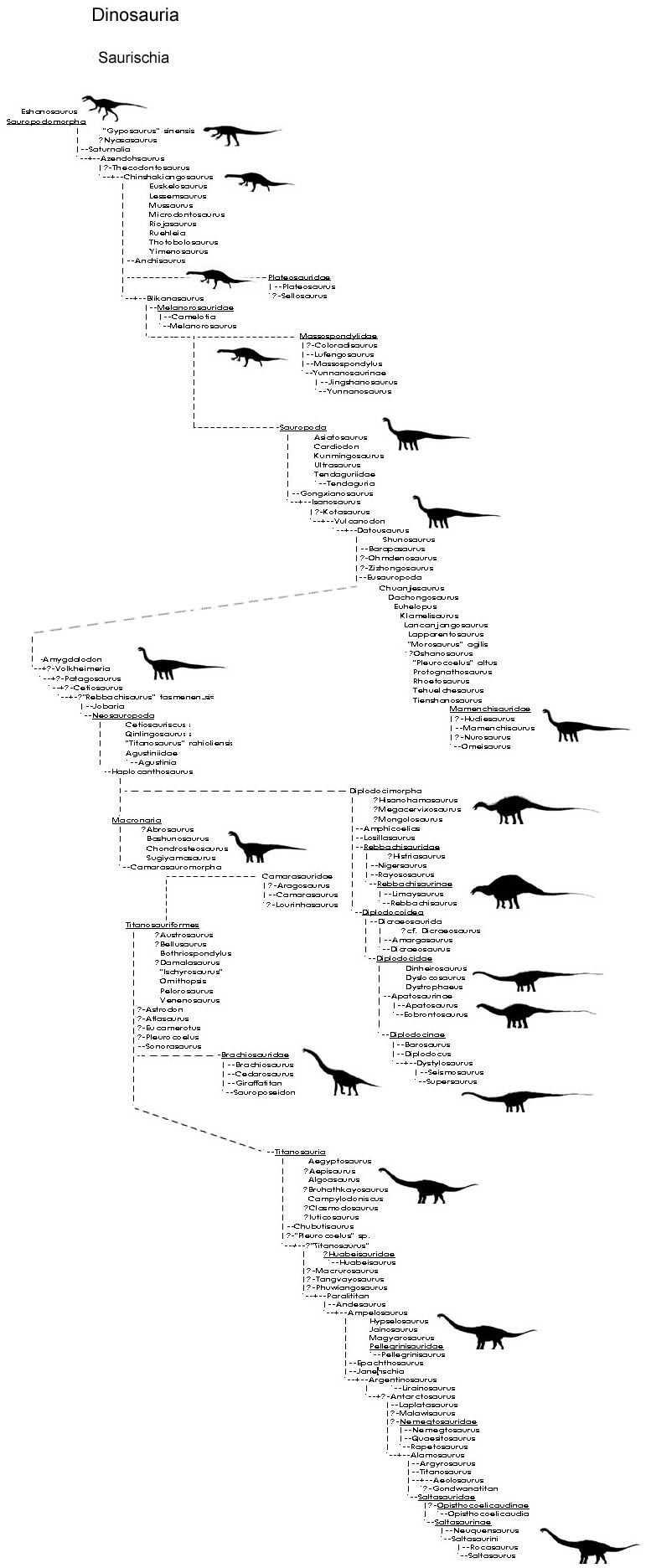
Sauropodomorpha and correcting myself

Original Source for the image http://www.gavinrymill.com/dinosaurs/Cladogram/SaurischiaSauropodmorpha.jpg


I said, I would source a rant about phylogeny later and this is my attempt to do so. Already, I have blogged about Crocodilians and Ceratopsians. In the original rant, I wrote:

May I ask, what is your view point? You point to this chart as evidence that “one thing, stayed one thing and never changed into anything else! What we see in the world today and what we read in the Bible is consistent and true.” As already mentioned “W” is Ceratopsians. Do you hold that transitioning from a biped to a quadruped is not changing? “O” is Prosauropods and “P” is Sauropods. Do you hold that quasi-quadruped prosauropods transitioning into sauropods is changing? If “W” is OK, then why is “O” to “P” not OK?

As I already mentioned there are at least three bipedal families in the generally quadruped ceratopsians. By Kerby [1] and Answers in Genesis [2], this is considered variation within a kind. However in this particular phylogeny, prosauropods and sauropods are separate branches. Kerby seems to suggest that each separate branch are their own separate “one thing” that “stayed one thing”.

Prosauropods, like ceratopsians, are both bipedal and quadrupeds[3]. They are named “prosauropods”, because they were thought to have evolved into sauropods. They seemed to be transitioning into obligatory quadrupeality. They grew bigger and their necks grew longer.[4] 

It is difficult to know what Answers in Genesis thinks about prosauropods. The word, “prosauropod”, does not occur on the Creation Museum website. It appears only once on the Answers in Genesis website. [5] Searching for “sauropod” on Answers in Genesis, yields over 300 hits. One contains the following quote:

Sauropods just appear and disappear in the fossil record, without connection and without explanation. According to The Complete Dinosaur, “The ancestry of the sauropods, before they burst onto the world scene on almost every continent in the Middle Jurassic, is obscure.”

No known process of change could derive them from any other known organism, and no evidence of such change is found in the fossil record.
[6]

The rest of the paragraph in The Complete Dinosaur, reads:

Seems obvious
when you read
the chart :)
The frequent assumption that they arose from prosauropods, probably melanorosaurids, has yet to be verified. Furthermore, some characters, including the reduction of the fifth digit of the hind foot in all prosauropods (but not in sauropods), suggest that these animals were already too specialized to have served as sauropod ancestors, and that the sauropods may have arisen as a sister group in the Late Triassic. Indeed, the traditional assumption that the quadrupedal sauropods developed from bipedal prosauropods was questioned as early as 1965 by A.J. Charig, J. Attridge, and A.W. Crompton. [7]

So now we come to the portion of this blog where I need to
correct something in my rant. The current prevailing hypothesis is not that prosauropods evolved into sauropods, but that both prosauropods and sauropods share a common ancestor. I stated the following:
Do you hold that quasi-quadruped prosauropods transitioning into sauropods is changing?
As mentioned in The Complete Dinosaur this has long been known not to be the likely case. However, the question can be redeemed...I hope. Why is it not likely that both prosauropods and sauropods are the same kind or in Kerby’s language, “one thing”?

Grazing through Answers in Genesis, it is difficult to know what they think. Again, they only mention prosauropods by name once. They also seem reluctant to assign a non-sauropod ancestor.[8] [9] [10]

Ceratopsians and Phylogeny


I have been writing a series, critiquing Carl Kerby’s critique of a phylogenic chart. My main point has been that the chart does not say what Kerby says that it says. Kerby argues that the chart shows that “one thing stayed one thing and never changed into anything else.” I’ve brought up that the lines on the chart represent orders and sub-orders of animals. One of the limbs on the tree even represents birds. Within these orders and sub-orders are immense diversity. In the original post, I brought this up.

Just look at "W" which represents the suborder Ceratopsians. They were both bipedal and quadrupeds.

Kerby works with Answers in Genesis and both he and they generally argue that all ceratopsians are one created kind.

Even though breeding studies are impossible with dinosaurs, by studying fossils one can ascertain that there was likely one Ceratopsian kind with variation in that kind and so on.[1]

As I pointed out, ceratopsians do not just include the four legged dinosaurs that remind everyone of Triceratops. It also includes bipeds like Yinlong[2] and Psittacosaurus[3]. There are actually three different families of bipedal ceratopsians[4]. Clearly, Kerby and Answers in Genesis both accept Yinlong and Triceratops as diversity within created kinds.

 If this amount of diversity is accepted, I fail to see why feliformia cannot be considered a single created kind.  Surely the differences between Yinlong and Triceratops are no bigger than the differences between Hyaenidae (hyenas) and Felidae (biting cats and Sabre-tooth cats).[5]


Sunday, September 23, 2012

Are Crocodilians one thing?

A couple of months ago, I wrote a blog post about someone misrepresenting phylogenetic charts.
It is difficult to see, but the red line to the far left represents what used to be referred to as "Crocodilians".  The third red line from the top left represents "birds".  Now, I mainly took issue with the following statement.  
According to the chart, everything changed incredibly fast for 30 million years, then many didn’t change for the next 150 million years! Truth be told, it’s actually much worse than that. The fossil record actually contains things that are dated back to 400 million years and they are exactly the same as what we see today! Call me skeptical, but I find it hard to believe that an animal can stay exactly the same for long long of a time period...

...What these charts actually show is that one thing, stayed one thing and never changed into anything else! What we see in the world today and what we read in the Bible is consistent and true.

The fossil record confirms that one thing, stayed one thing, and never changed from, or into, anything else. Consider these quotes from non-creationists that support our conclusion.

In my original post, I pointed out that this is not what the chart says at all.  These red lines represent large amounts of diversity.
If you were to zoom in on that infraorder you would find that evolutionists think they changed for the next 150 million years producing new genera and species. For example, lions are a species. Their genus includes tigers, leopards, and jaguars. Their family includes other cats like pumas and house cats. Their sub-order, Feliformia, includes also hyenas, mongooses, meerkats, etc... Their order, Carnivora, includes bears, seals, dogs, etc... It is misleading to say that the order of Crocodilians did not change when an order or infraorder contains a lot of diversity. Just look at "W" which represents the suborder Ceratopsians. They were both bipedal and quadrupeds.

Well, I found a blog post by palaeozoologist Darren Naish explaining the taxonomy of what used to be called "Crocodilians".

Firstly – a minor point on nomenclature. This sort of thing has to be discussed whenever crocodilians are. The group of archosaurs conventionally called crocodilians, and frequently termed Crocodilia in the textbooks (that is, living crocodiles, alligators, gharials and all their crocodile-like, alligator-like and gharial-like fossil relatives) is now most typically termed Crocodyliformes. That is, ‘crocodilians’ of tradition are now crocodyliforms (note that the last ‘e’ gets dropped when you convert a ‘-formes’ name to its vernacular version). Within Crocodyliformes, the crown-group (that is, the group that contains the living species and all descendants of their most recent common ancestor) is termed Crocodylia. So, Crocodylia is a clade within Crocodyliformes (Clark in Benton & Clark 1988, Norell et al. 1994, Salisbury & Willis 1996, Brochu 2003).

Crocodyliformes is part of a more inclusive group that also includes the crocodyliform-like sphenosuchians, and this larger clade is termed Crocodylomorpha. In turn, Crocodylomorpha is part of a major archosaur group informally termed the crocodile-branch or crocodile-group archosaurs, the best technical name for which is (unfortunately) Pseudosuchia (how I hate the fact that this name might win out over Crurotarsi, if certain phylogenetic definitions are followed).

Massively simplified cladogram of crocodilians and their relatives, with numerous lineages not shown. The affinities between "rauisuchians", aetosaurs and crocodylomorphs are shown here as being unresolved, but some studies find aetosaurs to be closer to crocodylomorphs than are other croc-group archosaurs. Other studies find at least some "rauisuchians" to be closer to crocodylomorphs than are other croc-group archosaurs. Within Crocodylomorpha, some studies find thalattosuchians to be further away from Crocodylia than is Notosuchia.
In view of the confusion that ensues whenever an attempt is made to explain the use and meaning of these names (I’ve had to do it several times), I believe that we should stick with what we have: the archosaurs that we imagine as ‘crocodilians’ are now crocodyliforms, and the crocodyliform crown-clade is Crocodylia. However, some workers aren’t happy with this and have argued that we should use Crocodylia in place of Crocodyliformes (Martin & Benton 2008). I can’t see that this does anything useful bar complicate an already confusing situation and I think that we should ignore this proposal. When talking to technical audiences, I tend to use crocodyliform, but I don’t see anything wrong with ‘crocodilian’ being used as a vernacular term for the clades Crocodyliformes or Crocodylomorpha. [1]

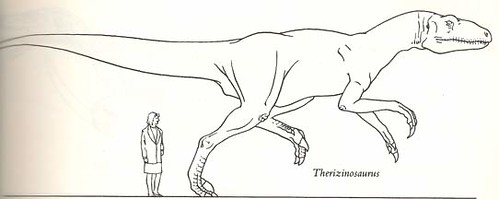
In my last post, I made a comment about therizinosaurs.
They belong to “m” on your chart, the clades “Carnosaurs and Coelurosaurs”. Therizionosaurs, are in the clade, Coelurosaurs, and all posses sloth like giant claws. How can “m” which represents two parallel clades teach that “one thing stayed one thing”? Also, how is anything becoming a Therizinosaur not becoming a new thing?
I would like to echo that comment here.  The red line marked "Crocodilians" includes thalattosuchians.  How can anyone consider a group that includes these aquatic reptiles and alligators as "one thing stayed one thing"?   Clearly this chart does not teach that "everything changed incredibly fast for 30 million years, then many didn't change for the next 150 million years".  Thalattosuchians are thought to have evolved in the early Jurrasic.  

Whatever you believe about the Theory of Evolution, it is unwise to misrepresent information.  

Thursday, July 26, 2012

Late night ramblings on Phylogeny...

[I will probably source a lot of this later, but this is what I wrote in response to Phylogenic Charts.  A similar post is available here.  The chart is so difficult to read.  The file name is even Dino-Chart-Small.jpg.  He does not source the chart with anything other than the book title, Dinosaur Data Book.  As far as I can tell, this is the bibliographical data. 

Lambert, 1990. The Dinosaur Data Book. New York: Avon Books.

"The Dinosaur Data Book" (1990) p. 125
The book was later reprinted in 1998 with somewhat of an update.[1]  Also, I mention Therizinosaurus were not being mentioned.  Apparently they are mentioned, but without complete skeletons they were thought to be carnivorous predators.  Anyways, here it goes:]
"According to the chart, everything changed incredibly fast for 30 million years, then many didn’t change for the next 150 million years!"
If I am reading your chart right, the numbers represent orders and clades of animals. The furthest to the right, #3, represents Crocodilians. Within that order, there are several families, genera, and species. "P" represents the famed long necked Sauropods which have many genera and species. If you were to zoom in on that infraorder you would find that evolutionists think they changed for the next 150 million years producing new genera and species. For example, lions are a species. Their genus includes tigers, leopards, and jaguars. Their family includes other cats like pumas and house cats. Their sub-order, Feliformia, includes also hyenas, mongooses, meerkats, etc... Their order, Carnivora, includes bears, seals, dogs, etc... It is misleading to say that the order of Crocodilians did not change when an order or infraorder contains a lot of diversity. Just look at "W" which represents the suborder Ceratopsians. They were both bipedal and quadrupeds.

Also, your chart was published in the "Dinosaur Data Book". When was it printed? The edition I found was printed in 1990, about 22 years ago. Has there been any more fossil evidence since then?

You quoted from What Evolution Is. If you continued the quote you would have noticed that he said:
The discovery of unbroken series of species changing gradually into descending species is very rare.
He then points out that fossilization is rare and most fossils remain buried, because they are not close enough to the surface. He does not seem to “support” your conclusion. His book is available on Scribd if you think that I am wrong on assessing his point of view.

http://www.scribd.com/doc/43553720/Ernst-Mayr-What-Evolution-is-Copy

The other book review that you cite also does not seem to support your conclusion since he is speaking in more a historical context.

May I ask, what is your view point? You point to this chart as evidence that “one thing, stayed one thing and never changed into anything else! What we see in the world today and what we read in the Bible is consistent and true.” As already mentioned “W” is Ceratopsians. Do you hold that transitioning from a biped to a quadruped is not changing? “O” is Prosauropods and “P” is Sauropods. Do you hold that quasi-quadruped prosauropods transitioning into sauropods is changing? If “W” is OK, then why is “O” to “P” not OK?

Your chart, which again I assume is from around 1990 says, “j-m are flesh-eaters collectively called therapods”. This statement is out of date. In the mid-90’s a feathered herbivore therapod clade was discovered called Therizinosaurs. They belong to “m” on your chart, the clades “Carnosaurs and Coelurosaurs”. Therizionosaurs, are in the clade, Coelurosaurs, and all posses sloth like giant claws. How can “m” which represents two parallel clades teach that “one thing stayed one thing”? Also, how is anything becoming a Therizinosaur not becoming a new thing?

Lastly #6 is birds. Does this prove that God created the Class Birds as “one thing stayed one thing and never changed into anything else”?

You said, “The fossil record actually contains things that are dated back to 400 million years and they are exactly the same as what we see today!” Are you talking about the Coelacanth genus Latimeria? There is no fossil record for the specific genus Latimeria. There is a fossil record for the order Coelacanth.

PS ~ The text on the chart reads:


Ruling reptiles. This family tree shows the likely evolution of dinosaurs, birds, crocodilians and pterosaurs from within the mixed group of early archosaurs called thecodonts. For explanations of names see chapters 2 and 3. A Triassic Period. B Jutassic Period. C Cretaceous Period. 1 Armored archosaurs. 2 Thecodonts. a Proterosuchians. b Erythrosuchids. c Rauisuchians. d Aetosaurs. e. Phyosaurs (alias parasuchians). f Ornithosuchids. g Euparkeriids. h Lagosuchids. 3 Crocodilians. 4 Pterosaurs. 5 Dinosaurs. i Herrerasaurs. 5A Saurischian dinosaurs (j-m are flesh-eaters collectively called theropods). j Deinonychosaurs. h Oviraptorosaurs. m Carnosaurs and coelurosaurs. n Segnosaurs. o Prosauropods. p Sauropods. 5B Ornithischian dinosaurs. q Fabrosaurids. r Scelidosaurs. s Stegosaurs. t Ankylosaurs. u Ornithopods. v Heterodontosaurids. w Ceratopsians. x Pachycephalosaurs. 6 Birds.

I still cannot read the dates.  The Triassic is generally about 50 million years, but he says the chart has only 30 million years.  My only explanation (without a legible copy of the chart) is that the chart begins with the emergence of dinosaurs in the mid-triassic.