Showing posts with label quran. Show all posts
Friday, February 24, 2012
How to dispose of the Quran correctly
...It is important to give a Quran a proper burial, says Omid Safi, professor of Islamic studies at the University of North Carolina and author of “Memories of Muhammad.” Any text containing the name of God is sacred in Islam. God is revealed through scripture, and anything associated with writing it has a religious significance, Mr. Safi says.
One could literally bury the Quran, ideally in a place with little foot traffic. Another option is to put the book in a flowing body of water, either letting it sink or be carried away. Regardless of the method, treating the book’s destruction with respect is paramount. Safi likens it to a poor man’s funeral, where the book might be wrapped in a shroud before being placed in the ground and mourned.
Burning the Quran, however, is also an accepted practice.
“People often ask, ‘if it’s OK for Muslims to burn the Quran, then why isn’t it OK for the US military to do it?’” Safi says. “That’s where the question of symbolism is important.”
Some say erasing the names of God and his messengers prior to burning the Quran makes it acceptable, but Safi says it’s even simpler than that. It comes down to context: Burning the text in a dumpster with trash on a US military base feels less respectful than treating the disposal with reverence in a burial or sacred burning.
Safi finds one analogy particularly helpful: The Quran is to Islam as Jesus is to Christianity. “In an Islamic universe ... the word becomes not a person, but a book,” he says. “For a Muslim to see the Quran burnt not as a way of burial, it would look and feel like someone burning Jesus, or a crucifix.”
But contextualizing today’s protests goes beyond simple reverence for the Quran, Safi says. “Bagram airbase is one of the central places of US military presence in Afghanistan ... [and] between 600 and 700 Afghans have been detained or are being detained there for years and years.”
Safi says this isn’t so much a theological debate on how to dispose of the Quran properly, but a charged conversation around a military force “that’s being looked at as an occupying force ... [A]n unlawful, violent force.” [1]
WSJ:Protests Against Quran-Burning Roil Afghanistan
KABUL—Afghanistan's government and religious leaders failed to mollify angry worshippers Friday, as a new wave of protests against the burning of Qurans at a U.S. military base swept across the country.
While most of Friday's demonstrations ended peacefully, several degenerated into turbulent clashes between Afghan police and marchers chanting anti-American slogans.
| Afghan demonstrators shout anti-US slogans as they carry a wounded man during a protest in Herat on Friday |
The deadliest such clash took place in Herat, a normally tranquil city in western Afghanistan, where demonstrators tried to march toward the U.S. consulate compound. At least six people were killed and 65 injured during confrontations with the Afghan security forces protecting the building, according to Mahiddin Noori, a spokesman for the Herat governor. The protesters failed to reach the consulate.
All in all, at least 20 people have been killed, including two U.S. soldiers, in four days of violence that erupted after U.S.-led coalition forces at the Bagram Airfield tried to burn a truckload of Islamic literature, including copies of the Quran, Islam's holy book.
Afghan workers said they rescued the books from the incinerator and then smuggled them off the base to show to local leaders. That ignited an escalating series of violent protests that have targeted coalition military bases, Afghan government buildings, United Nations offices and other symbols of Western presence in the country.
The U.S. has tried to mute the anger by launching an investigation and repeatedly apologizing for the occurrence. On Thursday, President Barack Obama expressed his "deep regret" to President Hamid Karzai in a personal letter to the Afghan president in which he vowed to hold to account those responsible for the Bagram incident.
U.S. military officials have said the books were set aside for destruction because Afghan detainees at the Parwan military detention center at Bagram were using them to trade messages and share extremist writing. But it remains unclear why the soldiers decided to burn copies of the Quran—a particularly incendiary affront to Muslims who view the book as the sacred word of God as relayed to the Prophet Muhammad.
On the eve of Friday's protests, Mr. Karzai and the country's religious leaders tried to limit the violence by urging people to express their anger peacefully. Preachers in mosques across Kabul tried to reinforce that message during Friday's weekly prayers.
"Those who burned the Quran are illiterate," thundered a preacher in Kabul's Khaled Ibn Walid mosque. "They don't know what religion is, but for us the solution is not violent demonstrations that kill our own people."
Similar messages in mosques across Kabul prevented chaotic anti-American marches from sweeping the city center. But elsewhere in the country and in the outskirts of Kabul, Afghan police trying to block the marchers from converging on Western compounds clashed with protesters.
In Herat, shooting erupted as hundreds of protesters, some of them armed, tried to march toward the U.S. consulate, local officials said. Outside the city, demonstrators burned two police stations, Mr. Noori said.
As worshippers gathered for Friday prayers, U.S. Marine Gen. John Allen, commander of the International Security Assistance Force in Afghanistan, urged Afghans to be patient and wait for the results of the investigation.
"Working together with the Afghan leadership is the only way for us to correct this major error and ensure that it never happens again," he said in a statement.
On Thursday night, Gen. Allen, accompanied by the Afghan Army Chief of Staff Gen. Sher Karimi, flew to a joint U.S.-Afghan base in eastern Afghanistan where an Afghan soldier opened fire on American forces during a protest earlier that day, killing two.
"Now is not the time for revenge," Gen. Allen told U.S. soldiers gathered at the small base in Nangarhar province. "Now is the time to look deep inside your souls and remember your mission. Now is how we show the Afghan people that, as bad as that action was at Bagram, it was unintentional, and American's and ISAF soldiers do not stand for this." [1]
Also this is from ABC on the timing of the apology.
The White House says the president’s apology was conveyed before the U.S. troops were killed today.
Furthermore, the administration notes that the apology, which was included in a lengthy three-page letter from Obama to Karzai on a range of issues, is not unprecedented. In 2008, President Bush apologized to Iraq’s prime minister for an American sniper’s shooting of a Koran.[2]
Friday, January 6, 2012
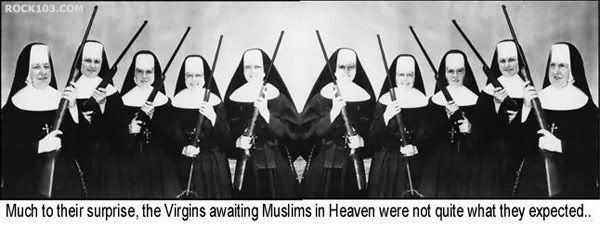
Funny take on 72 virgins
Obviously, I do not read Arabic so I cannot speculate on the validity of her exegesis. Still, this is funny from Muslim who converted to Atheism.
Misconception #5: They’re actually white raisins, not virgins.
This one is has been widely popularized by the less-harsh critics of Islam, notably Irshad Manji. While I respect the work that she does from the inside (reforming Islam is a tough goal), the scholarship that suggests that “virgins” is a mistranslation of “raisins” is shaky at best. Beyond the well-recognizedlinguistic issues with the raisins idea, there is plenty in both the Quran and Hadith to point to the reward in heaven being women, not dried fruit.
Misconception #4: Having to teach all of those virgins would be tedious.
The virgins in Jannah are supposed to be everything that men desire. Furthermore, the ancient Arabs’ conception of the highest in sexual pleasure is penile-vaginal intercourse with a woman who has never had sex, so the idea was the utmost in sexual pleasure, not tedium.
Misconception #3: They wouldn’t be virgins for very long.
The houris’ virginity is described as eternally renewable, similar to that of Aphrodite in ancient mythology.
Misconception #2: Seventy-two is an arbitrary number.
Seventy-two, in classical Arabic, is a number used for exaggeration. It is similar to saying “If I told you once, I told you a thousand times” in English. No one literally means a thousand times; what is intended is countless times. Taking into account the Arab conception of virgins, seventy-two virgins, then, means more sexual pleasure than could be imagined.
Misconception #1: The virgins are from Earth.
This is, by and large, the most common misconception. Random people on the Internet did it. Family Guy did it. Even The New Yorker did it.The joke is, of course, that the “virgins” are not nubile women, but the types of people on Earth who tend to, at least stereotypically, stay virgins their whole lives, such as World of Warcraft players (that assumption is a fallacy itself, of course). Where the joke falls flat for those in the know, like me (and, soon, you), is that the houris are not human beings from Earth who died without having had sex, but are supposed to be heavenly maidens especially created to sate the lusts of men as understood by Muhammad...
...Oh, and why did the concept of houris make me doubt my faith? Not only did the idea of heavenly sex-bots awaiting my future Muslim husband trigger my insecurities, I was pissed off that I, as a woman, would not get my own sex-bots. [1]
Misconception #5: They’re actually white raisins, not virgins.
This one is has been widely popularized by the less-harsh critics of Islam, notably Irshad Manji. While I respect the work that she does from the inside (reforming Islam is a tough goal), the scholarship that suggests that “virgins” is a mistranslation of “raisins” is shaky at best. Beyond the well-recognizedlinguistic issues with the raisins idea, there is plenty in both the Quran and Hadith to point to the reward in heaven being women, not dried fruit.
Misconception #4: Having to teach all of those virgins would be tedious.
The virgins in Jannah are supposed to be everything that men desire. Furthermore, the ancient Arabs’ conception of the highest in sexual pleasure is penile-vaginal intercourse with a woman who has never had sex, so the idea was the utmost in sexual pleasure, not tedium.
Misconception #3: They wouldn’t be virgins for very long.
The houris’ virginity is described as eternally renewable, similar to that of Aphrodite in ancient mythology.
Misconception #2: Seventy-two is an arbitrary number.
Seventy-two, in classical Arabic, is a number used for exaggeration. It is similar to saying “If I told you once, I told you a thousand times” in English. No one literally means a thousand times; what is intended is countless times. Taking into account the Arab conception of virgins, seventy-two virgins, then, means more sexual pleasure than could be imagined.
Misconception #1: The virgins are from Earth.
This is, by and large, the most common misconception. Random people on the Internet did it. Family Guy did it. Even The New Yorker did it.The joke is, of course, that the “virgins” are not nubile women, but the types of people on Earth who tend to, at least stereotypically, stay virgins their whole lives, such as World of Warcraft players (that assumption is a fallacy itself, of course). Where the joke falls flat for those in the know, like me (and, soon, you), is that the houris are not human beings from Earth who died without having had sex, but are supposed to be heavenly maidens especially created to sate the lusts of men as understood by Muhammad...
...Oh, and why did the concept of houris make me doubt my faith? Not only did the idea of heavenly sex-bots awaiting my future Muslim husband trigger my insecurities, I was pissed off that I, as a woman, would not get my own sex-bots. [1]
Wednesday, December 28, 2011
Favorite verse in the Quran
Abraham argues with a pagan about the supremacy of God. Abraham notes that God is so powerful that He causes the sun to rise in the East. Let us see if you can get it to rise in the West.
~ Surat Al-Baqarah (The Cow) 2:258[1]
Labels:
abraham,
cow,
geocentric,
islam,
quran,
Sun,
surat al-baqarah
Subscribe to:
Posts (Atom)