Showing posts with label devil. Show all posts

Tuesday, June 19, 2012

Martin Luther and the changeling


The Story of a Changeling at Dessau

Eight years ago [in the year 1532] at Dessau, I, Dr. Martin Luther, saw and touched a changeling. It was twelve years old, and from its eyes and the fact that it had all of its senses, one could have thought that it was a real child. It did nothing but eat; in fact, it ate enough for any four peasants or threshers. It ate, shit, and pissed, and whenever someone touched it, it cried. When bad things happened in the house, it laughed and was happy; but when things went well, it cried. It had these two virtues. I said to the Princes of Anhalt: "If I were the prince or the ruler here, I would throw this child into the water--into the Molda that flows by Dessau. I would dare commit homicidium on him!" But the Elector of Saxony, who was with me at Dessau, and the Princes of Anhalt did not want to follow my advice. Therefore, I said: "Then you should have all Christians repeat the Lord's Prayer in church that God may exorcise the devil." They did this daily at Dessau, and the changeling child died in the following year.... Such a changeling child is only a piece of flesh, a massa carnis, because it has no soul.

It seems likely that this Changeling was a child with autism.

Changelings from the Devil

Changelings and killcrops are laid in the place of legitimate children by Satan in order to plague mankind. He often pulls certain girls into the water, impregnates them, and keeps them with him until they deliver their children; afterward he places these children in cradles, taking the legitimate children away. But such changelings, it is said, do not live more than eighteen or nineteen years.


The Killcrop of Halberstadt


A man who lived near Halberstadt in Saxony had a killcrop who had sucked his mother and five additional wet nurses dry. Further, he was eating a great deal and behaving very strangely. The man was told that he should take the child on a pilgrimage to Hockelstadt to praise the Virgin Mary and to have him weighed there. The peasant followed this advice and set forth, carrying the child in a basket. But when he came to a bridge over some water, a devil in the water beneath the bridge called out: "Killcrop! Killcrop!" The child in the basket, who had never yet spoken a word, answered: "Ho! Ho!" This startled the peasant. The devil in the water then asked: "Where are you going?" The killcrop said: "I'm on my way to Hockelstadt to Our Dear Lady, to have myself weighed there so that I may grow." When the peasant heard the changeling speak, the first time this had ever happened, he became angry and threw the child into the water, basket and all. Then the two devils came together, shouted "Ho, ho, ha!," played with each other, rolled around with each other, and disappeared.

Satan plagues mankind with such changelings and killcrops by substituting them for real children. Satan has the power to exchange children, placing a devil in the cradle in the place of a child. This devil will suck and eat like an animal, but it will not grow. Thus it is said that changelings and killcrops do not live longer than eighteen or nineteen years.

It happens often, that babies are exchanged during their first six weeks, and that devils lay themselves in their place, making themselves detestable by shitting, eating, and crying more than any ten other children. The parents get no rest from such filthy beasts. The mothers are sucked dry and are no longer able to nurse.... However, changeling children should be baptized, because they cannot always be recognized as such during their first year.
[1]

Wednesday, February 15, 2012

Gloucester Sea Serpent


In August 1817, reports of a 60- to 70-foot-long sea beast reached a fever pitch in Gloucester, Mass., after numerous witnesses claimed seeing a huge serpent moving rapidly through the harbor. This was not the first time — nor the last time — the people of Massachusetts would report such a sight. Serpent sightings were noted as early as the 1630s, but none were taken as seriously as those in 1817. The creature was said to have a turtle-like head adorned with a spear or horn and a body as wide as a barrel. The reports gained so much momentum that the Linnaean Society of New England assembled a team to collect evidence, and Gen. David Humphreys (a former member of George Washington's staff) traveled to the scene to collect eyewitness accounts.

Shortly after the occurrence, the Linnaean Society of New England published a report stating that the sighting was evidence of a new type of animal, which they dubbed Scoliophis atlanticus. Unfortunately for the society, though, Scoliophis atlanticus was often parodied more than appreciated. There were some who took more kindly to the society's pamphlet and to the belief that such a monster trolled the great seas. In April 1859, more evidence of the serpent's existence became available when a creature that fit the description of the Gloucester sea serpent allegedly attacked the British sailing vessel Banner while at sea.
[1]

Sunday, December 11, 2011

When Giants Built Churches :)


No description of Innsbruck, however brief, could be deemed complete without at least a passing reference to the famous Abbey of Wilten which stands on the outskirts of the south-western portion of the town. The present Abbey belonging to the Praemonstratensian Order was founded in the eleventh century upon the site where stood the Roman settlement of Veldidena. The Abbey and Church of that day, however, have been so frequently damaged by fire that during the centuries it has been practically reconstructed. The story of its foundation forms one of the most remarkable of Tyrolese legends, and exhibits in its incidents with extraordinary clearness the conflict taking place in those times between the doctrines of Christianity and Heathendom.

Certain authorities state that the Romans, when they entered the country, found a town already existing, which they adopted as one of their most important stations, and re-named Veldidena. This settlement, however, was, according to tradition, destroyed by Attila on his way back through the country after the desperate Battle of Chalons; but it nevertheless continued to be a largely frequented station in the stretch of country lying between the Po and the Rhine owing to the convenience of its situation and the existence of the famous Brenner Road. Afterwards came the expedition of Theodoric of Verona against Chriemhild's Garden of Roses at Worms;
[about AD 500] and we are told amongst those who enlisted in Theodoric's service and distinguished themselves at the taking of the famous Rose Garden was one Ilaimo or Haimon (now believed to be the Heime of "the Heldenbuch") who, after the expedition, came through Tyrol in his master's victorious train. This Haimon was a giant, taller and more powerful even than Goliath himself; and as he approached Veldidena he found barring his progress another giant named Thyrsus (now identified as Schrudan) living near Zirl. This latter giant having heard of Haimon's prowess, and as his own supremacy had hitherto remained unchallenged, determined to force Haimon to fight him.

Theodoric's giant proved willing enough for the encounter, and scarcely, indeed, waited to be challenged. Thyrsus, although the bigger and more terrible of aspect, with a skin bronzed by the open-air life he had led, and his muscles developed and kept in condition by constant exercise, was not so skilful and wily as his opponent, whose every movement showed him to be a master in both the arts of attack and defence.

We are told that Thyrsus grasped in his hand a pine tree which he had torn up by the roots to serve as a weapon, and that at every movement of his the ground shook under his tread, which made a noise like thunder. Rushing impetuously to attack Haimon he found the latter cool and collected, watchful of his antagonist's every movement, and waiting patiently for the opportunity of striking a decisive blow. As the Titanic struggle went on, Haimon merely acting on the defensive, Thyrsus became weary, and then Haimon gathering all his force together fell upon him and slew him.

The story goes on to tell how a Benedictine monk of Tegernsee, passing whilst Haimon was still flushed with victory, stopped to reason with him on the worthlessness of mere brutal strength and all that he had hitherto deemed of value, and succeeded so well in painting the attractions of a better life that the giant was converted on the spot, and thenceforth abandoned his life of battle and bloodshed, and devoted his time and strength to the service of God. One of his first acts was to start building with his own hands a church and monastery on the site of ruined Veldidena on the banks of the Sill.

The legend tells us that he quarried the stone necessary for this undertaking with his own hands, and at last the day came when he had sufficient to lay the foundations of the church. He found, however, that the work he did in the day was always undone at night, so that he made no progress. This, though he did not know it, was the work of the devil; who, in the form of a huge dragon, had hidden himself in a cave with the express purpose of thwarting Haimon's pious intentions.

At last the latter realized that he must watch and discover what happened. This he did, and after a little time one evening the dragon emerged from his cave, lashing the ground with his tail in his fury, and filling the air with the sulphurous smoke and flame which he breathed out . Great as was his strength, Haimon at once realized that he could not overcome so terrible an enemy easily; so commending his soul to God he waited with a brave heart. Soon dawn began to break over the mountains, and at the first glimpse of light the dragon turned and fled back to his lair. Haimon, taking courage at the] sight, set off in pursuit, and by-and-by they both arrived at the cave in which the dragon was accustomed to hide during the day. The entrance was so narrow that when the monster had got partly in it was impossible for him to turn, and so Haimon, seeing his opportunity, raised his sword, and calling on God to strengthen him, cut off the dragon's head with a single blow. Then he cut out the tongue or sting of the monster as a trophy, and eventually hung it up in the sanctuary of the church. Nowadays one is shown at Wilten a representation of this dragon's tongue, which we are told was above two feet in length.

The dragon once dead the building progressed rapidly, and when it was finished Haimon, no doubt in an ebullition of joy, seized a huge rock, which he had quarried, but did not need to use for the foundations, and threw it with all his might into the valley. It was a good throw, for the rock, after nearly two miles of flight, struck against the hill of Ambras and fell into the valley, where it may yet be seen! Haimon endowed the Abbey with all the land which stretched between its site and the stone at the foot of the hill of Ambras.

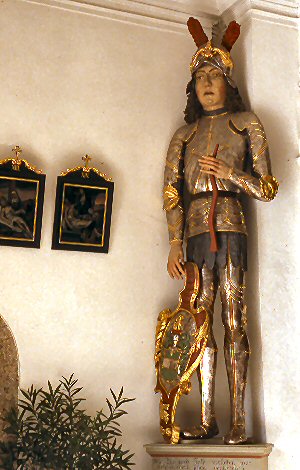
Now it only remained to colonize the monastery, and ultimately the Benedictines came to inhabit it, and here the giant lived amongst them a life of penance and good works, dying in the year 878. His body, so tradition states, was buried on the right-hand side of the high altar in the church. But although many searches have been made for his remains during the period which elapsed between his death and the middle of the seventeenth century, they have never been discovered. But the last search in 1644 was disastrous as well as unsuccessful, because it undermined a great part of the wall of the church, which collapsed. The popular belief in the two giants is kept alive by the huge wooden statues representing them, which are placed at the entrance of the church. The interior of the building is in the form of a basilica, and contains not only frescoes by Caspar Waldmann, but also some good pictures by Grasmayr, Busjager, Andersag, Egid Schor, and other artists.
[1]

Mentioned in another account, Thyrsus' blood sprinkled over the land which became the oil springs.[2]