Showing posts with label china. Show all posts

Wednesday, May 23, 2012

Croc with a sail


The family trees of birds and crocodiles meet somewhere in the early Triassic and archosauriforms are the closest cousin to those archosaurs, Nesbitt said. But the new research places X. sapingensis firmly within the archosaur family tree, providing evidence that the early members of the crocodile and bird family trees evolved earlier than previously thought.

"This animal is closer to a crocodile, but it's not a crocodile. If you saw it today you wouldn't think it was a crocodile, especially not with a sail on its back," he said.
[1]

Thursday, April 12, 2012

Red Deer Cave People


Remains of possibly four individuals of the so-called "Red Deer Cave People" were unearthed in southwest China and may represent a new species of human.

The fossils from two caves, date to just 14,500 to 11,500 years ago. Until now, no hominid remains younger than 100,000 years old have been found in mainland East Asia resembling any other species than our own.

"We have discovered a new population of prehistoric humans whose skulls are an unusual mosaic of primitive, modern and unique features -- like nothing we've seen before," said Darren Curnoe, associate professor in the School of Biological, Earth & Environmental Sciences at the University of New South Wales and lead author of a study about the find in the journal PLoS One.

"They have rounded brain cases with prominent brow ridges, flat but short faces with a broad nose, jutting jaws that lack a human chin, their brains are moderate in size with modern-looking frontal lobes but primitive short parietal lobes, and they have large molar teeth," added Curnoe .
[1]

Friday, March 23, 2012

American citizenship is not worth having?

“There certainly should be some honor and dignity in American citizenship that would be scarred from the foul and corrupting taint of a debasing alienage.  Are Chinese children born in this country to share with the descendants of the patriots of the American Revolution to exalted qualification of being eligible to the Presidency of the nation? If so, then verily there has been a most degenerate departure from the patriotic ideals of our forefathers; and surely in that case American citizenship is not worth having.” 

US Attorney Henry Foote, United States v. Wong Kim Ark, 1898[1]

Thursday, February 23, 2012

Fossil Forests in China


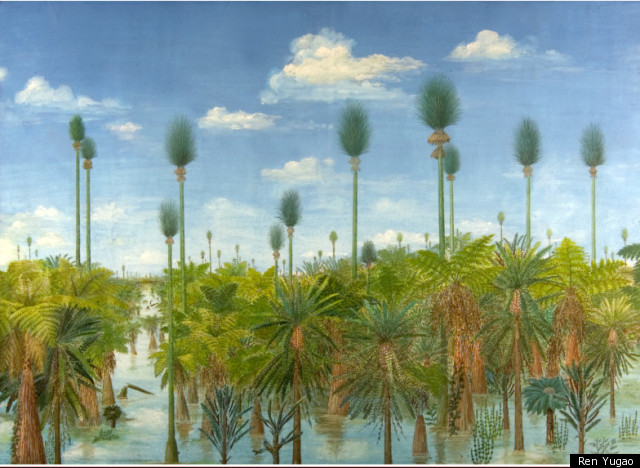
An ancient swampy forest full of long-extinct plant species has been brought to life through analyses of well-preserved fossils entombed in a layer of volcanic ash. Although many of the species are already known to science, the eruption that smothered the tropical forest in what is now northern China created a time capsule that reveals an almost unprecedented level of detail about the region’s flora, scientists say.

Palaeoecologists can usually only infer the richness of an ancient forest ecosystem by piecing together fossils of plant fragments of varying ages. Only when broad areas are preserved in situ in a geological instant can researchers get a true picture of the composition and ecology of the forest, says Hermann Pfefferkorn, a palaeoecologist at the University of Pennsylvania in Philadelphia. Although floods can cover wide swathes of landscape with sediment in one fell swoop, they often bring in organisms from other areas and wash local inhabitants away. The most reliable preservation, Pfefferkorn suggests, comes from a smothering layer of volcanic ash.

Pfefferkorn and his colleagues have unearthed one such time capsule from 298-million-year-old rocks in northern China — a 'forest Pompeii' where the weight of falling ash ripped leaves from twigs, toppled trees and then buried the lot. The consistent thickness of ash deposits in the region, as well as the size of individual ash particles, suggest that the volcanic blast occurred more than 100 kilometres away.
Forest of ferns

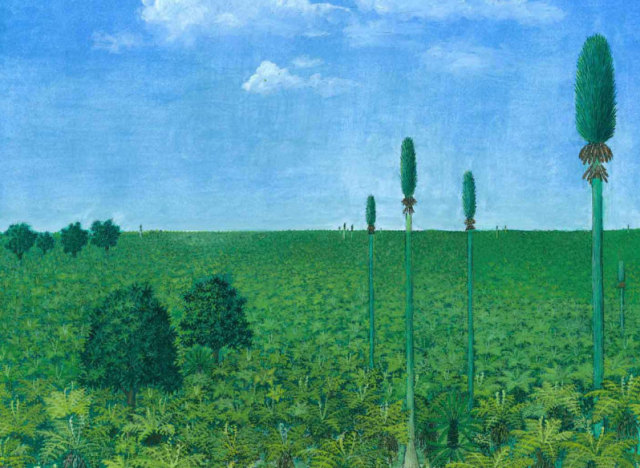
The researchers reconstructed the ancient ecosystem by analysing the positions of individual plants across three sites that together cover more than 1,000 square metres. Species from six plant groups lived there, Pfefferkorn and his team report online today in the Proceedings of the National Academy of Sciences1. Besides sporting a broad, low canopy of tree ferns, the peat forest contained trees that looked like feather dusters, with trunks twice the height of telephone poles; vines and three species of an enigmatic group called Noeggerathiales — small spore-bearing trees that scientists think are close relatives of the earliest ferns.

“This is a wonderful study,” says Robert Gastaldo, a palaeobotanist at Colby College in Waterville, Maine. “Many of these plant groups we knew from other places, but we had no idea that they actually grew together.”

The team’s findings “provide a view into the guts of a coal-forming swamp in its prime”, says Scott Elrick, a geologist with the Illinois State Geological Survey in Champaign.

When the forest was alive, it sat on the northwestern edge of a large tropical island off the eastern shore of the supercontinent Pangaea, the researchers say. Most forests like this one had died out elsewhere millions of years earlier — their habitats had dried as landmasses comprising the supercontinent came together and the forests ended up farther from the coasts, says Ralph Taggart, a palaeoecologist at Michigan State University in East Lansing. In that sense, he notes, even before it was buried, this peat forest was already frozen in time as forests elsewhere evolved.
[1]

Friday, November 25, 2011

Honey Laundering?


They're calling it "honey laundering." More than three-fourths of the honey sold in U.S. grocery stores is filtered to the point where it contains no pollen -- which would make it flunk the quality standards set by most of the world's food safety agencies, according to testing done by Food Safety News.

The Food and Drug Administration says that any product that's been so ultra-filtered that it no longer contains pollen isn't honey. However, the FDA does not check honey sold here to see if it contains pollen. The food safety divisions of the World Health Organization, the European Commission and dozens of others have ruled that without pollen there is no way to determine whether honey came from legitimate and safe sources.

Ultra filtering is a process where honey is heated, sometimes watered down and then forced at high pressure through extremely small filters to remove pollen, which is the only foolproof sign identifying the source of the honey.

Food Safety News bought more than 60 jars, jugs and plastic bears of honey sold in various outlets in 10 states and the District of Columbia. The contents were analyzed for pollen by Vaughn Bryant, a professor at Texas A&M University and one of the nation's premier melissopalynologists, or investigators of pollen in honey.

Bryant, who is director of the Palynology Research Laboratory, found that among the containers of honey:

• 76 percent bought at groceries had all of the pollen removed. Stores included TOP Food, Safeway, Giant Eagle, QFC, Kroger, Metro Market, Harris Teeter, A&P, Stop & Shop and King Soopers.

• 100 percent of the honey from drugstores like Walgreens, Rite-Aid and CVS Pharmacy had no pollen.

• 77 percent of the honey from big box stores like Costco, Sam's Club, Walmart and Target had the pollen filtered out.

• 100 percent of the honey in the small packets from Smucker, McDonald's and KFC had the pollen removed.

On the plus side, Bryant found that every one of the samples from farmers markets, co-ops and "natural" stores like PCC and Trader Joe's had the full, anticipated, amount of pollen.

If you have to buy at major grocery chains, the analysis found that your odds are better of getting honey that wasn't ultra-filtered if you buy brands labeled as organic. Out of seven samples tested, five (71 percent) were full of pollen.

This is an issue because most of this filtered honey probably originally comes from China, where it is tainted by illegal animal antibiotics and heavy metals--but without the pollen, it is impossible to trace its origin. Also, some nutritionists say pollen imparts health benefits.

The FDA actually cracked down about 10 years ago on crappy Chinese honey imports, so China just started "laundering" their honey through other Asian countries like India and Vietnam. Of the 208 million pounds of honey the U.S. imported over the last 18 months, almost 60 percent came from Asian countries, according to FSN.

"FDA does not consider 'ultra-filtered' honey to be honey," agency press officer Tamara Ward told Food Safety News, but added: "We have not halted any importation of honey because we have yet to detect 'ultra-filtered' honey." But many in the honey industry and some in the FDA's import office told FSN that they doubt the FDA checks more than 5 percent of all foreign honey shipments. FSN says the FDA has ignored repeated pleas from Congress, beekeepers and the honey industry to develop a U.S. standard for identification for honey.

And therein lies the sting.
[1]