"What if we had the bodies of 50,000,000 babies piled on top of each other in a museum somewhere?"
Just doing the math: Assuming current rates, about 78.9% of those 50,000,000 were 10 weeks or less, mean they were about an inch long or less. That is 39,450,000 grape sized embryos or about the equivalent to 90,000 gallon swimming pool. 9.1%, 4, 550,000, were 11-12 weeks and about 2 inches which adds about another 21,000 gallons. 6.6% were 13-15 weeks and up to 4 inches long which is about another 30,000 gallons. 3.8%, 1,900,000, were at the most 10 inches or about 43,000 gallons. Even being generous, the 1.5%, 750,000 that were over 20 weeks were generously 20 inches or at the most about 34,000 gallons. Total about 220,000 gallons.
I don't know if it would make the point that she wants it to make. On the one hand, seeing all those aborted at one time could make a point. On the other hand, you could physically put all those aborted into one location 1/3 the size of an Olympic swimming pool. More to her point about late term abortion, 10 weeks and less abortion amount for 78.9% of abortions, but only 41% of the contents of our hypothetical abortion exhibit. One could use this as an argument to prevent later term abortions, but the vast majority of mothers would not abort an 11 week old fetus.
Sources - http://www.lifesitenews.com/twenty-weeks-pregnant-with-twins-but-last-week-she-had-an-abortion.html
http://www.guttmacher.org/pubs/fb_induced_abortion.html
http://www.traditionaloven.com/culinary-arts/volume/convert-sphere-1-in-d-to-galon-gal-us.html
http://www.babycenter.com/slideshow-baby-size?slideNumber=7
Showing posts with label prolife. Show all posts
Showing posts with label prolife. Show all posts
Friday, August 16, 2013

Tuesday, December 4, 2012
Who doesn't think that they are alive?

This is the second generation of this strawman that I have seen on Facebook. I used to think that everyone knew that it was a strawman, until I started seeing friends repeat it and someone posted it in one of the threads that I was commenting on. OK, first watch this Sesame Street video to learn what is alive.
Does that Paramecium on the left, breath and eat and grow? [1] Certainly it does. Does that 24 to 26 week old fetus on the right, breath and eat and grow? [2] Certainly she does. (Human embryos and fetuses generally default to the female gender) So who is saying that a growing fetus with sleep cycles and a 40-90% chance of surviving outside of the womb [3] is not "life"? The answer is no one. Also, 88% of abortions happen in the first twelve weeks. Only 1.5% of abortions are performed on fetuses over 20 weeks. [4] Most people who get abortions do not wish to terminate fetuses over 20 weeks. Let's try this next one.

The picture is of a one hour old single cell embryo. [5] Now let's try the Sesame Street test. Does she breath and eat and grow? Certainly she does. Who dares to challenge the wisdom of the muppets? The answer is no one.
At an hour old, this single cell has an up hill battle. About 19.6 out of every 1000 women annually will have an abortion. This means that 22% of pregnancies will end in abortion [4], but this embryo only has about a 30-70% of even implanting in the uterus to transition from conception to pregnancy. [6] Even if she implants, she may not implant in the uterus. Ectopic pregnancies occur at 19.3 out of every 1000 pregnancies or about 2% of pregnancies. [7] Once implanted correctly, she still has about a 31% chance of miscarrying. [8] Things get a little more dicey when you considered that one out of eight embryos form twins, but only one out of 80 twins make it to birth. [9] All of this adds up to the embryo having as great as a 70% chance of not surviving to birth [8].
 |
| Tubal Pregnancy |
Correction 12/5/2012: This post originally said that 19.6% of 1000 pregnancies end in abortion. This was an error on my part. It should have said 1000 women. The abortion rate is about 11 times the ectopic pregnancy rate. I apologize for the error.
Friday, March 2, 2012
2008:"A person's a person no matter how small."
 What is it about this children's book
That fills Dr. Seuss fans with such scorn?
Anti-abortion groups took a look
At Horton and they saw the unborn.
We all learned to read with the books written by Theodor Seuss Geisel and grew up with characters from the "Cat in the Hat" and "Yertle the Turtle" to the "Sneetches and the Grinch."
But do the books have a hidden meaning?
Since the 1980s, some anti-abortion rights groups have interpreted the book "Horton Hears a Who" as an anti-abortion parable.
If you don't remember, it's the tale of Horton the elephant who discovers a whole town of tiny people living on a speck of dust. Though his neighbors think he's crazy and make fun of him, Horton makes it his mission to protect his new friends, declaring his intention with the famous line:
"A person's a person no matter how small."
Despite the fact that the book was written in the 1950s, long before the legalization of abortion in 1973, the statement has become an anthem to legions of anti-abortion rights activists.
"Horton Hears a Who" has the message that every single person, no matter how small, deserves protection," says Kristi Burton, who leads Colorado for Equal Rights, a group that has drafted a state ballot initiative stating that life begins at conception.
"That's what our amendment is saying. Obviously, it uses legal language but it says the same thing."
Burton led a group of several dozen activists who attended the movie premiere of "Horton Hears a Who" in Denver Friday to praise the film's message and hand out T-shirts with Horton's famous statement.
That could get them in trouble with Dr. Seuss Enterprises, which represents the interests of the late author. According to Seuss biographer Phil Nel, Geisel threatened to sue an anti-abortion rights group during the 1980s that used the statement on its stationery, forcing them to back down.
Burton insists that her group talked to attorneys to make sure that they could reprint the sentence on their shirts. A lawyer for Dr. Seuss Enterprises did not return calls seeking comment.
As for the author himself, Nel says that he is not aware of Geisel ever publicly expressing his opinion on abortion.
"But given that he was a liberal Democrat who favored women's rights, it's fair to infer that he did not support that [anti-abortion] agenda."
Geisel's widow, Audrey, did not return calls seeking comment. But Karl ZoBell, the lawyer for Dr. Seuss Enterprises, told National Public Radio that "She doesn't like to hijack Dr. Seuss characters or material to front their own points of view."
Since the book was published in 1954, the same year as the landmark civil rights decision Brown vs. Board of Education, it was widely interpreted as a paean to the rights of minorities. One reviewer praised it as a "rhymed lesson in protection of minorities and their rights."
It's not the only Dr. Seuss book to arouse controversy and conflicting messages.
"The Lorax," a parable about the plight of the environment and the destruction caused by industrialized society, has been banned in some schools and libraries for its anti-timber industry focus. A group of timber companies even created its own version of the book, a logging-friendly tome called "The Truax."
Nel says that some of Geisel's books were shaped by his liberal politics.
"The Sneetches" was inspired by his opposition to anti-Semitism, but it also works as an anti-discrimination parable. "The Butter Battle Book" was a critique of Reagan's escalation of the nuclear arms race and "Yertle the Turtle" is an anti-fascist book inspired by Hitler."
Even the "Cat in the Hat" has a larger purpose beyond just teaching kids how to read, says Nel. "It's all about challenging authority. There's a theme in Seuss' book of the outsider, usually a child character, speaking up and making himself heard and making a difference. Look at little Jo Jo [in "Cat in the Hat']. It's his voice that puts them over the top."[1]
Tuesday, February 21, 2012
NPR Blog: Where are the women?

The all-male witness panel at Thursday's House hearing on President Obama's contraception insurance mandate inspired Representative Carolyn B. Maloney, a Democrat from New York, to ask "Where are the women?" A photo of the lineup quickly circulated the Internet—appearing on Twitter and Facebook feeds and landing on women's rights advocacy blogs.
Maloney's question—"Where are the women?"—is a familiar one in our office. As the debate around contraceptive coverage continues, several listeners have written with the same concerns about NPR's coverage.
The All Things Considered segment, "Week in Politics," on Feb. 10 drew the most concern. The weekly segment regularly features Washington Post columnist E. J. Dionne and New York Times columnist David Brooks. The two columnists discuss the political wave of the week and, between Dionne's traditionally liberal perspective and Brooks' conservative-leaning views, listeners generally can find something they agree with, including even a compromise.
But the difference between the two was missing when the hot subject last week was the debate over contraception coverage. As Linda Fleck of Roslindale, MA, wrote:
Now that the issue of women's right to birth control has come to the fore, I think that it is inappropriate that E.J. Dionne be allowed to speak for the left insofar as he has apparently decided to subordinate women's health concerns to Catholic dogma. Perhaps someone like Gail Collins could substitute for Mr. Dionne while this matter rages in Washington. Both points of view need to be aired (versus the current "Amen" chorus of Brooks and Dionne). Women's rights matter. Women's voices need to be heard on this issue.
She is right on one level, though this isn't to say that the two should be prohibited from addressing contraception or any other issue. Brooks and Dionne offer their opinions every Friday on whatever topics may come their way. More important, it seems to me, is to look at how this one segment fits into the whole of NPR's coverage. Did it overall commit the same sin?

Julia Ro/NPR
Our intern Stephannie Stokes reviewed all of NPR's on-air coverage of the controversy between Jan. 13 and Feb. 13. The results were gratifying. Of those interviewed and quoted, 26 were women, ranging from Catholic students to lawyers to professors. This compares to 18 men who were quoted by name. Worth noting, moreover, is that the women represented both sides of the issue, countering the assumption that all women voices would speak in favor of the administration's new policy.
The search did not include those quoted indirectly, or reporters or hosts of NPR shows.
A report recently released by ThinkProgress, a project of the left-leaning Center for American Progress, analyzed coverage on cable and broadcast news of the administration's contraception mandate. It found a grimmer picture for gender sensitivities. Of the 146 guests brought on cable news shows to weigh in on the free insurance, for example, 55 were women and 99 were men.
Airing diverse voices and views that reflect the country is critical. A diverse staff helps in gathering diverse views. The Women's Media Center, an organization that advocates for increased female representation in the media, recently released "The Status of Women in the U.S. Media 2012." The study found that women are still underrepresented in several media areas—print journalism being an immediate example.
Let me know if you see something I don't see concerning gender and NPR. Your critiques help keep NPR accountable.
Stephannie Stokes contributed to this post.[1]
WebMD: Blighted Ovum
A blighted ovum occurs when a fertilized egg implants in the uterus but doesn't develop into an embryo. It is also referred to as an anembryonic pregnancy and is a leading cause of early pregnancy failure or miscarriage. Often it occurs so early that you don't even know you are pregnant.
A blighted ovum causes about one out of two miscarriages in the first trimester of pregnancy. A miscarriage is when a pregnancy ends on its own within the first 20 weeks.
In the not-so-distant past, women were urged to cut down on or even avoid exercise during pregnancy. Today, we know differently. Not only is it OK to participate in fitness activities during pregnancy, but doing so can have a positive impact on both baby and mom. "You need to be physically active during pregnancy. It has terrific benefits that are associated with a better pregnancy outcome and even shorter labors. It's a win-win for baby and for mom," says high-risk pregnancy expert Laura Riley,...
When a woman becomes pregnant, the fertilized egg attaches to the uterine wall. At about five to six weeks of pregnancy, an embryo should be present. At about this time, the gestational sac -- where the fetus develops -- is about 18 millimeters wide. With a blighted ovum, though, the pregnancy sac forms and grows, but the embryo does not develop. That's why a blighted ovum is also called an anembryonic pregnancy.
What Causes a Blighted Ovum?
Miscarriages from a blighted ovum are often due to problems with chromosomes, the structures that carry genes. This may be from a poor-quality sperm or egg. Or, it may occur due to abnormal cell division. Regardless, your body stops the pregnancy because it recognizes this abnormality.
It's important to understand that you have done nothing to cause this miscarriage and you almost certainly could not have prevented it. For most women, a blighted ovum occurs only once.
Signs of a Blighted Ovum
With a blighted ovum, you may have experienced signs of pregnancy. For example, you may have had a positive pregnancy test or a missed period.
Then you may have signs of a miscarriage, such as:
- Abdominal cramps
- Vaginal spotting or bleeding
- A period that is heavier than usual.
If you're experiencing any of these signs or symptoms, you may be having a miscarriage. But not all bleeding in the first trimester ends in miscarriage. So be sure to see your doctor right away if you have any of these signs.
Diagnosing a Blighted Ovum
If you thought you had a normal pregnancy, you're not alone; many women with a blighted ovum think so because their levels of human chorionic gonadotropin (hCG) may increase. The placenta produces this hormone after implantation. With a blighted ovum, hCG can continue to rise because the placenta may grow for a brief time, even when an embryo is not present.
For this reason, an ultrasound test is usually needed to diagnose a blighted ovum -- to confirm that the pregnancy sac is empty.
What Happens After a Miscarriage?
If you have received a diagnosis of a blighted ovum, discuss with your doctor what to do next. Some women have a dilation and curretage (D & C). This surgical procedure involves dilating the cervix and removing the contents of the uterus. Because a D & C immediately removes any remaining tissue, it may help you with mental and physical closure. It may also be helpful if you want a pathologist to examine tissues to confirm the reason for the miscarriage.
Using a medication such as misoprostol on an outpatient basis may be another option. However, it may take several days for your body to expel all tissue. With this medication, you may have more bleeding and side effects. With both options, you may have pain or cramping that can be treated.
Other women prefer to forego medical management or surgery. They choose to let their body pass the tissue by itself. This is mainly a personal decision, but discuss it with your doctor.
After a miscarriage, your doctor may recommend that you wait at least one to three menstrual cycles before trying to conceive again.[1]
"sperm-egg union is a necessary condition for conception, but not a sufficient condition."
...Do such things as hydatidiform moles, choriocarcinoma, blighted ovum, and clones prove that human life does NOT begin at conception?
There is a second argument for implantation as the decisive moment: If we say that full humanness begins at conception, we must respond to the observation that "some entities that stem from the union of sperm and egg are not 'human beings' and never will develop into them," and that there may be some human beings who come into being without the union of sperm and egg.[4]
Nathanson gives examples of nonhuman entities that result from the sperm-egg union:
- hydatidiform mole ("an entity which is usually just a degenerated placenta and typically has a random number of chromosomes")
- choriocarcinoma ("a 'conception-cancer' resulting from the sperm-egg union is one of gynecology's most malignant tumors")
- blighted ovum ("a conception with the forty-six chromosomes but which is only a placenta, lacks an embryonic plate, and is always aborted naturally after implantation").
The problem with Nathanson's argument is that he confuses necessary and sufficient conditions. One who holds that full humanness begins at conception is not arguing that everything which results from the sperm-egg union is necessarily a conception. That is, every conception of a unique individual human entity is the result of a sperm-egg union, but not every sperm-egg union results in such a conception. Hence, the sperm-egg union is a necessarycondition for conception, but not a sufficient condition.
Furthermore, Nathanson is correct in asserting that it is possible that some day there may be human beings, such as clones, who come into existence without benefit of conception.
[6] But this would only mean that conception is not a necessarycondition for full humanness, just as the sperm-egg union is not asufficient condition for conception.
In sum, Nathanson's argument from both nonhuman products of sperm-egg unions and the possibility of clones is inadequate in overturning the pro-life position that full humanness begins at conception.
Spontaneous abortions.
It is estimated that twenty to fifty percent of all conceptions die before birth. Thirty percent, it is estimated, die before implantation.
[7] Some people argue that these facts make it difficult to believe that the unborn are fully human in at least the very earliest stage of their development prior to implantation. But this is clearly an invalid argument, for it does not logically follow from the number of unborn entities who die that these entities are not by nature fully human.
Suppose the pro-choice advocate responds to this by arguing that if every fertilized ovum is human, then we are obligated to save all spontaneous abortions as well. But if we did, it would lead to overpopulation, death by medical neglect, and starvation. The problem with this response is that it confuses our obvious prima facie moral obligation not to commit homicide (that is, to perform an abortion) with the questionable moral obligation to interfere with natural death (that is, to permit the conceptus to abort spontaneously).
Protecting life is a moral obligation, but resisting natural death is not necessarily a moral duty...There is no inconsistency between preserving natural life, opposing artificial abortion and allowing natural death by spontaneous abortion.[8]
Admittedly, the question of interference in spontaneous abortions provokes the pro-life ethicist to think more deeply and sensitively about his or her position and to make distinctions and nuances that may not be pleasing to all who call themselves pro-life. But just as the difficult question of whether to pull the plug on the irreversibly comatose who are machine-dependent does not count against the position that murdering healthy adults is morally wrong, the question of how we should ethically respond to spontaneous abortions does not count against the pro-life ethic which says that we should notdirectly kill the healthy and normally developing unborn.
Twinning and recombination.
Some people argue that since both twinning (the division of a single conceptus) and recombination (the reuniting of two concepti) occur prior to implantation, individual human life does not begin until that time. However, a careful examination of the nature of twinning and recombination reveals that there is no reason to suppose that the original pre-twinned conceptus or any pre-recombined conceptus was not fully human.
First, scientists are not agreed on many aspects of twinning.
- Some claim that twinning may be a nonsexual form of parthenogenesis or “parenting.” This occurs in some animals and plants.
- Others claim that when twinning occurs, an existing human being dies and gives life to two new and identical human beings like himself or herself.
- Still others claim that since not all human concepti have the capacity to twin, one could argue that there exists in some concepti a basic duality prior to the split. Hence, it may be claimed that at least in some incipient form two individual lives were present from the start at conception.

Second, every conceptus, whether before twinning or recombination, is still a genetically unique individual who is distinct from his or her parents.
In other words, if identical twins result from a conceptus split or one individual results from two concepti that recombine, it does not logically follow that any of the concepti prior to twinning or recombining were not human.[10]
To help us understand this point, philosopher Robert Wennberg provides the following story:
Imagine that we lived in a world in which a certain small percentage of teenagers replicated themselves by some mysterious natural means, splitting in two upon reaching their sixteenth birthday. We would not in the least be inclined to conclude that no human being could therefore be considered a person prior to becoming sixteen years of age; nor would we conclude that life could be taken with greater impunity prior to replication than afterward. The real oddity—to press the parallel—would be two teenagers becoming one.From [ChristianAnswers.net]
However, in all of this we still would not judge the individual's claim to life to be undermined in any way. We might puzzle over questions of personal identity... but we would not allow these strange replications and fusions to influence our thinking about an individual's right to life. Nor therefore does it seem that such considerations are relevant in determining the point at which an individual might assume a right to life in utero." [11]
Wednesday, February 15, 2012
When women have abortions

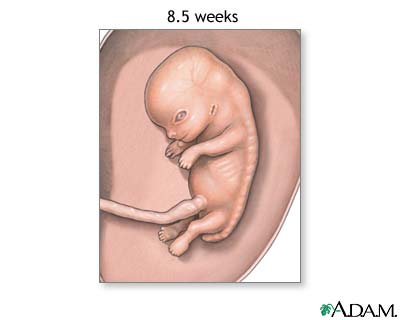
- 61.8% of abortions occur within the first 9 weeks
- About 88% occur in the first 12 weeks
- About 98% occur before 21 weeks
 |
 |

The embryo and fetus pictures came from this great NIH website. The chart came from Guttmacher. The motivation for this blog comes from a silly thought. If you can graduate from an American High School believing that a 12 week old fetus is a "blob of cells". We have a major education problem in this country.
Sunday, February 12, 2012
Catholic: Ectopic Pregnancy
On February 8th I said the following on Facebook:
Many Catholics use birth control. I suspect that even though doctrine commands that a woman should die rather than terminate her ectopic pregnancy, most Catholic doctors and most Catholic women choose to terminate the pregnancy. Does anyone know a Tebow like testimony where a woman chose to die from her ectopic pregnancy?
Many Catholics use birth control. I suspect that even though doctrine commands that a woman should die rather than terminate her ectopic pregnancy, most Catholic doctors and most Catholic women choose to terminate the pregnancy. Does anyone know a Tebow like testimony where a woman chose to die from her ectopic pregnancy?
I misunderstood the following section of the Catholic Encyclopedia.
After these and other similar decisions had been given, some moralists thought they saw reasons to doubt whether an exception might not be allowed in the case of ectopic gestations. Therefore the question was submitted: "Is it ever allowed to extract from the body of the mother ectopic embryos still immature, before the sixth month after conception is completed?" The answer given, 20 March, 1902, was: "No; according to thedecree of 4 May, 1898; according to which, as far as possible, earnest and opportune provision is to be made to safeguard the lifeof the child and of the mother. As to the time, let the questioner remember that no acceleration of birth is licit unless it be done at a time, and in ways in which, according to the usual course of things, the life of the mother and the child be provided for". Ethics, then, and the Church agree in teaching that no action is lawful which directly destroys fetal life. It is also clear that extracting the living fetus before it is viable, is destroying its life as directly as it would be killing a grown man directly to plunge him into a medium in which he cannot live, and hold him there till he expires.
However, if medical treatment or surgical operation, necessary to save a mother's life, is applied to her organism (though the child's death would, or at least might, follow as a regretted but unavoidable consequence), it should not be maintained that the fetal life is thereby directly attacked. Moralists agree that we are not always prohibited from doing what is lawful in itself, though evilconsequences may follow which we do not desire. The good effects of our acts are then directly intended, and the regretted evilconsequences are reluctantly permitted to follow because we cannot avoid them. The evil thus permitted is said to be indirectly intended[1]
After these and other similar decisions had been given, some moralists thought they saw reasons to doubt whether an exception might not be allowed in the case of ectopic gestations. Therefore the question was submitted: "Is it ever allowed to extract from the body of the mother ectopic embryos still immature, before the sixth month after conception is completed?" The answer given, 20 March, 1902, was: "No; according to thedecree of 4 May, 1898; according to which, as far as possible, earnest and opportune provision is to be made to safeguard the lifeof the child and of the mother. As to the time, let the questioner remember that no acceleration of birth is licit unless it be done at a time, and in ways in which, according to the usual course of things, the life of the mother and the child be provided for". Ethics, then, and the Church agree in teaching that no action is lawful which directly destroys fetal life. It is also clear that extracting the living fetus before it is viable, is destroying its life as directly as it would be killing a grown man directly to plunge him into a medium in which he cannot live, and hold him there till he expires.
However, if medical treatment or surgical operation, necessary to save a mother's life, is applied to her organism (though the child's death would, or at least might, follow as a regretted but unavoidable consequence), it should not be maintained that the fetal life is thereby directly attacked. Moralists agree that we are not always prohibited from doing what is lawful in itself, though evilconsequences may follow which we do not desire. The good effects of our acts are then directly intended, and the regretted evilconsequences are reluctantly permitted to follow because we cannot avoid them. The evil thus permitted is said to be indirectly intended[1]
Gingrich says life begins at implantation
GINGRICH: Well, I think the question of being implanted is a very big question. My friends who have ideological positions that sound good don’t then follow through the logic of: ‘So how many additional potential lives are they talking about? What are they going to do as a practical matter to make this real?’
I think that if you take a position when a woman has fertilized egg and that’s been successfully implanted that now you’re dealing with life. because otherwise you’re going to open up an extraordinary range of very difficult questions [1]
Thursday, February 2, 2012
In 2005, who provided the abortions?

While looking for abortion information, I came across this study published in 2008, Abortion in the United States: Incidence and Access to Services, 2005.[1]
- 1/3 of abortion providers are hospitals, but hospitals only performed 5% of abortions.
- 62% of hospitals that performed abortions performed 30 or less abortions in 2005.
- Twenty hospitals reported 400–999 abortions, and only seven reported 1,000 or more.
- 1/5 of abortion providers are physician offices, but physician offices only performed 2% of abortions.
- 53% of physician offices reported fewer than 30 abortions in 2005.
- 80% of abortions are performed in a facility that performs 1000 or more abortions.
- 381 specialized abortion clinics performed 69% of all abortions.
- 435 nonspecialized clinic providers performed 25% of abortions.
Abortion providers are suffering financially from the decline in abortions. Last year, a hospital was forced to stop providing elective abortions, because of lack of demand.[2] Also, notice that Planned Parenthood provides about 1/3 of abortions, but abortion is only about 3% of its services. The vast majority of abortions in 2005 were provided by specialized abortion clinics. If all goes well, abortion will continue to decline.
Monday, January 16, 2012
The Scariest Quote about Black Genocide
“Before we saw the movie, I was pro-choice,” said Markita Eddy, a sophomore. But were she to get pregnant now, Ms. Eddy said, “it showed me that maybe I should want to keep my child no matter what my position was, just because of the conspiracy.” [1]
There are many better reasons to do the right thing than a strawman.
Good Summary of the Black Genocide Arguments
...But many abortion foes focus on the sheer numbers involved.
Catherine Davis, minority outreach director for Georgia Right to Life, visits black college campuses, bringing the message that abortion is a destructive force for blacks. She often screens a movie called "Maafa 21," made by Texas antiabortion group Life Dynamics, alleging that blacks have been targeted for abortions since the end of slavery by white elites fearful of uncontrolled population growth.
"Let me put it this way," Davis said, "18,870,000 black babies have been aborted since Roe vs. Wade. If those babies hadn't been aborted, we would be 59 million strong -- over 19% of the population."
While the abortion rate among black women is higher than average, so is the birth rate. According to the National Center for Health Statistics, in 2006 the black birth rate was 16.5 per 1,000 women of childbearing age compared with 14.2 per 1,000 for all women.
Most black women who have abortions are already mothers or plan to have children later, Cullins said.
The statistics are not persuasive for Alveda King, a niece of Martin Luther King Jr.
"I know for sure that the black community is being targeted by abortionists for the purpose of ethnic cleansing," said King, a Georgia Right to Life board member who had two abortions before a religious conversion in 1983. "How can the dream survive if we are willing to sacrifice the futures of our children?"
In a scenario popularized by abortion foes, the culprit is Planned Parenthood, whose clinics are often located in poor communities where the need for subsidized healthcare is greatest. [1]
Politifact:Planned Parenthood = Planned Genocide?

This presidential election season, Georgia’s homegrown prospect Herman Cain is talking about race.
Cain, a black, conservative Republican, recently said the media is "scared that a real black man may run against Barack Obama."
And there’s this one about pro-abortion rights group Planned Parenthood:
"When Margaret Sanger - check my history - started Planned Parenthood, the objective was to put these centers in primarily black communities so they could help kill black babies before they came into the world," Cain said during a talk in Washington, D.C., at the Heritage Foundation, a conservative group.
"It's planned genocide," Cain added. He wants the U.S. Congress to yank funding for Planned Parenthood, which receives about $75 million a year to provide non-abortion health services.
Was Planned Parenthood founded to help kill unborn black babies?
Cain asked his audience to check his history. So, we did.
First, a disclaimer. Cain, who has launched a presidential exploratory committee, was a talk show host on AM 750 and now 95.5 FM WSB, which, like The Atlanta Journal-Constitution, is part of Cox Media Group.
Cain has more political heft than your average talking head. The former CEO of Godfather Pizza beat a six-term U.S. congressman to finish second in Georgia’s 2004 U.S. Senate Republican primary. The Morehouse grad has eight honorary doctorate degrees and has authored four books, and he serves on several corporate boards.
Now some history. Planned Parenthood founder Margaret Sanger is credited with making birth control legal and widely available.
Born 1879, Sanger, who was white, blamed her mother’s death on her frequent pregnancies. At the time, speaking about birth control could lead to arrest. She thought that if women could legally control the number of children they bore, their health and economic conditions would improve.
We consulted with scholarship, Cain’s camp, anti-abortion groups, Sanger’s biographer, and multiple experts on Cain’s claim.
The supposed evidence that Sanger supported black genocide is a loose collection of her most objectionable statements, her ties to the disgraced eugenics movement, and her work on what was called the Negro Project. That effort, started in 1939, brought birth control services (but not abortion) to black communities in the South.
These facts don’t come close to supporting Cain’s claim.
Eugenics was once a wildly popular theory that the human race can be improved through better breeding and genetics. It drew together backers as diverse as President Theodore Roosevelt and black intellectual W.E.B. DuBois.
At its best, the U.S. movement pushed for better prenatal care. At its worst, it enabled forced sterilization laws and let claims that blacks and immigrants were inferior to masquerade as science.
Sanger welcomed some of the movement’s more notorious leaders onto the board of a predecessor to Planned Parenthood. She also endorsed paying pensions to women of low intelligence who agreed to be sterilized.
But we found no evidence that Sanger advocated - privately or publicly - for anything even resembling the "genocide" of blacks, or that she thought blacks are genetically inferior.
Every academic PolitiFact Georgia consulted said that Cain’s claim is wrong.
"I have never run into any serious academic reference of Sanger or others wanting to ‘kill black babies,’" Indiana University professor Ruth Engs, a eugenics movement expert, told PolitiFact Georgia in an e-mail.
What’s worse, Cain got his facts mixed up.
Sanger’s first birth control clinic opened in 1916 in the Brownsville neighborhood of Brooklyn, N.Y., which was mostly Irish and Jewish.
When she did open a Harlem clinic in the early 1930s, about half of its patients were white. Members of the black establishment, including DuBois and black newspaper the Amsterdam News, supported it. This was hardly the pro-genocide camp.
None of these centers performed abortions.
Those who think Sanger wanted black genocide cite the Negro Project. But even their strongest evidence, a passage from a letter she wrote advocating that organizers recruit black ministers for the project, does not come close to proving a genocidal plot.
Sanger wrote that "We don’t want word to go out that we want to exterminate the Negro population and the minister is the man who can straighten out that idea if it ever occurs."
But her correspondence shows this sentence advocates for black doctors and ministers to play leadership roles in the Negro Project to avoid misunderstandings. Lynchings and Jim Crow laws gave blacks good reason to be wary of attempts to limit the number of children they bore. In Harlem, she hired a black doctor and social worker to quell those fears.
The facts of the Negro Project suggest nothing more genocidal than a public health project. Black leaders DuBois and Mary McLeod Bethune, founder of the National Council of Negro Women, and the pastor of the influential black Abyssinian Baptist Church were members of its advisory council. First lady Eleanor Roosevelt was supportive.
For Sanger to launch a genocidal plot behind their backs and leave no true evidence in her numerous writings would require powers just shy of witchcraft.
Really, calling the Negro Project a genocidal plot defies common sense. Why would Sanger try to destroy a race of people by giving them access to the very thing she thought could make life better?
Planned Parenthood’s early objective was not to "help kill black babies before they came into the world."
Sanger failed to rise above the ethnic and racial paternalism of her time, but that’s a far cry from being genocidal.
Cain’s claim is a ridiculous, cynical play of the race card. We rate it Pants on Fire. [1]
Sunday, January 15, 2012
Abortion Stats

- Non-Hispanic white women account for 36% of abortions, non-Hispanic black women for 30%, Hispanic women for 25% and women of other races for 9%.[Facts on Induced Abortion in the United States]
• Nearly half of all pregnancies among American women are unintended, and four in 10 of these end in abortion.[1]
• About half of American women will have an unintended pregnancy, [2] and nearly one-third will have an abortion, by age 45.[3]
• The overall U.S. unintended pregnancy rate remained stagnant between 1994 and 2006, but unintended pregnancy increased 50% among poor women, while decreasing 29% among higher-income women.[1]
• Overall, the abortion rate decreased 8% between 2000 and 2008, but abortion increased 18% among poor women, while decreasing 28% among higher-income women.[3]
• Some 1.21 million abortions were performed in 2008, down from 1.31 million abortions in 2000.[4]
• Nine in 10 abortions occur in the first 12 weeks of pregnancy.[5]
• A broad cross section of U.S. women have abortions:[3]
- 58% are in their 20s;
- 61% have one or more children;
- 56% are unmarried and not cohabiting;
- 69% are economically disadvantaged; and
- 73% report a religious affiliation. [Abortion in the United States]
Guttmacher's Census on Abortion Provider Locations
- * 63 percent of abortion providers are located in predominantly non-Hispanic white neighborhoods.
- * 12 percent are located in predominantly Hispanic neighborhoods.
- * 9 percent of abortion providers are located in predominantly black neighborhoods.
- * 1 percent of abortion providers are located in other predominantly non-white neighborhoods.
- * 15 percent of abortion providers were located in neighborhoods where no racial group constituted a majority of the population. [1]
1 in 8 Pregnancies Involve Twins
Though it sounds like a Stephen King title, vanishing twins are actually quite common. Researchers estimate that 1 in 8 pregnancies involve twin fetuses, yet only 1 in 80 pregnancies actually ends in the birth of twins [source: Goldman]. What happens to all those unborn twins? They die very early in the pregnancy and are simply reabsorbed by the mother's body. Spotting in the first trimester can be an indication of this occurrence. [1]
Sunday, December 11, 2011
NPR: Babies' Cells Linger, May Protect Mothers
February 8, 2006 - RENEE MONTAGNE, host:
What would you say if we told you that when a woman has a baby, she gets not just a son or daughter, she gets an army of protective cells--gifts from her children that will stay inside her and defend her for the rest of her life? It's such an enticingly beautiful idea, the scientists who proposed it worry that maybe it's too beautiful. NPR's Robert Krulwich has the story.
ROBERT KRULWICH reporting:
For years it was thought as soon as a baby is conceived, once it starts to grow inside a mom, it gets its own very private space.
Dr. KIRBY JOHNSON, PH.D. (Research Assistant Professor, Pediatrics, Tufts University School of Medicine): There is, there's a placenta.
KRULWICH: Yeah.
Dr. JOHNSON: Placenta was thought to be a fairly impenetrable barrier.
KRULWICH: So says Dr. Kirby Johnson, of Tufts University. The baby and its cells stay on the baby side. The mommy cells stay on the mommy side and nature keeps them separate until ...
(Soundbite of baby crying)
KRULWICH: It's, yeah, time to go. And here's the surprise. When scientists at Tufts took blood from ordinary pregnant moms ...
Dr. JOHNSON: We would find, for example, in a teaspoon of blood, dozens, perhaps even hundreds of cells.
KRULWICH: From the baby.
Dr. JOHNSON: From the baby.
KRULWICH: So, baby cells were slipping out of the placenta into the moms. But, because babies do have different genes ...
Dr. JOHNSON: One would expect them to be attacked fairly rapidly. You would expect them to be cleared within hours if not days. What we found is that that is not the case, not anywhere near the case.
KRULWICH: It turns out that babies' cells stay in their moms, not for days or weeks, but for decades.
Dr. JOHNSON: Four to five decades following the last pregnancy.
KRULWICH: So, 40 years after conception, that son or daughter who could now be a middle-aged pharmacist or somethin', yet their fetal cells, their baby cells, are still floating around inside the mother?
Dr. JOHNSON: Yes.
KRULWICH: Even his 60-year-old mother? 70?
Dr. JOHNSON: 70, 80, perhaps 90-year-old women.
KRULWICH: You're sure of this?
Dr. JOHNSON: Absolutely.
Dr. CAROL ARTLETT, PH.D. (Postdoctoral Fellow, Department of Medicine, Division of Rheumatology, Thomas Jefferson University): Yeah, these cells last essentially forever.
KRULWICH: In the mom!
Dr. ARTLETT: In the mom.
KRULWICH: And, says Carol Artlett, who studies fetal cells at Thomas Jefferson University in Philadelphia, even if a woman has a miscarriage or an abortion, even if there is no baby, the cells of an unborn child will stay in the mother for decades. But, why? What exactly are they doin' in there for years and years and years?
Dr. ARTLETT: (Laughs) That's a good question.
KRULWICH: (Laughs) Well, one early hypothesis--and it's not the nicest idea, says Kirby Johnson--is that certain autoimmune diseases...
Dr. JOHNSON: Such as lupus, rheumatoid arthritis, scleroderma are much more common in women than men and that's one component of the hypothesis is that this prevalence in women is due to fetal cells.
KRULWICH: So, later in life, when the mother's joints inflame, maybe it's her fetal cells--her own baby's--taking a poke at her. In fact, Kirby's mom did have an autoimmune disease. It was a bad one and for awhile Kirby thought, well, his cells were responsible.
Dr. JOHNSON: So, I apologized immediately and said, well, there's nothing much I can do about it.
KRULWICH: (Laughing) Yeah, yeah, but it's like, stop it, Kirby.
Dr. JOHNSON: But, you know what? I was always doing that to my mother. Always causing problems and it was just another in a long line of those kinds of things.
KRULWICH: But happily the folks at Tufts proposed an alternative, a second theory, to explain what fetal cells are doing in the moms.
Dr. JOHNSON: Well, theory number two is the polar opposite of theory number one.
KRULWICH: The good fetal cell hypothesis proposes that the son or daughter cells stay in mom, not to hurt her, but to protect, defend and repair her for the rest of her life whenever she gets seriously ill and that's a more attractive idea.
Dr. JOHNSON: It's such a personal thing and it does touch the heartstrings of even the most hardnosed research scientist.
KRULWICH: But they all have mothers.
Dr. JOHNSON: But they all have mothers.
KRULWICH: And happily they now have evidence--more and more evidence says Kirby Johnson--that looks like the good hypothesis may be correct. For example, here's a case.
Dr. JOHNSON: Well, this was a woman who came into a neighboring hospital in Boston with symptoms of hepatitis. She was an intravenous drug user ...
KRULWICH: And she had had five conceptions. She'd had one child, two miscarriages, two abortions, that's five in all; she could be carrying, therefore, a lot of fetal cells and they examined her ...
Dr. JOHNSON: And in the process, she had a liver biopsy ...
KRULWICH: And the doc said well, why don't we send her liver to the lab to see if there are any fetal cells gathering where she's got trouble, and when they looked ...
Dr. JOHNSON: We found hundreds...
KRULWICH: Wow!
Dr. JOHNSON: ...and hundreds of fetal cells.
KRULWICH: Normally they'd expect five or ten cells.
Dr. JOHNSON: But this was a very large--we saw, literally, sheets of cells, whole areas that seemed to be normal ...
KRULWICH: Meaning that those fetal cells had gathered at the liver and like stem cells, they just turned themselves, in this case, into healthy liver cells.
Dr. JOHNSON: And most interestingly, this woman did not desire to have any further treatment done. In fact, she wanted to get back to her normal life and be left alone.
KRULWICH: And so she left the hospital with hepatitis but when they checked months later, they learned ...
Dr. JOHNSON: That she is completely healthy, no signs of further liver damage ...
KRULWICH: So, no medical intervention, but just a huge number of her babies' fetal cells? Could that lead you to think the poetic thought, that she was saved by her kids?
Dr. JOHNSON: (Hesitates) We want to think that.
KRULWICH: (Laughs) I know you do.
Dr. JOHNSON: There, it's the most likely obser-, explanation.
KRULWICH: But, in science there is such a thing as a too dangerously beautiful idea.
Dr. JOHNSON: That's right, right! And we say the same thing to ourselves because it shows such a basic wonderful thing, but it has to be right and we can't be led astray by our own desire for it to be true.
KRULWICH: So they are systematically testing the good hypothesis and the bad hypothesis, all these ideas, on laboratory mice--and when they see mother mice with all kinds of diseases--infectious disease, cancer...
Dr. JOHNSON: Ovarian cancer, endometrial cancer, cervical cancers, we find fetal cells there. We know that fetal cells...
KRULWICH: Over and over and over and over?
Dr. JOHNSON: Over and over and over and over.
KRULWICH: Suggesting that fetal cells regularly rush to the places where they're needed in the mom, and, says Carol Artlett...
Dr. ARTLETT: There's a lot of evidence now starting to come out that these cells may actually be repairing tissue.
KRULWICH: That is, protecting the mom. While the other hypothesis, the fetal cells hurt the moms, there, the more they look, the less they find.
Dr. JOHNSON: I can't recall a single study that's been truly reproduced to verify the bad fetal cell hypothesis.
KRULWICH: So, while no one knows in the end which way it'll go...
Dr. JOHNSON: I think that that's something that we're going to see within the next five years or less.
KRULWICH: So far, a sense is building that fetal cells probably stay in mothers for decades to defend and to protect them, which increasingly, is a quiet consolation to Kirby Johnson, because it's now more likely that his cells and his brother's cells were helping their mom, not hurting, and even though his mother did die, Kirby's beginning to feel differently.
Dr. JOHNSON: Well, maybe if it wasn't for my brother and I, she may have passed a few years earlier. Maybe we bought her a couple of extra years of time so she could have a few more birthdays and a few more mother's days and then, if I can just say that, that there is some way where I can even have the remotest thought that I contributed to the extension of my mother's life, even if it was a few days, that would make all of the years that I've spent doing this research worthwhile.
KRULWICH: Robert Krulwich, NPR News, New York.[1]
This reminds me of two things. One, these cells are being used in new types of blood tests that will possibly replace the amniocentesis. If these tests work, mothers will know the gender and whether their child has Down Syndrome within the first eight weeks. There is some fear that this will create more selective abortions. Only 10% of Down Syndrome children are not aborted. Imagine if all mothers knew in the first trimester that their child had Down Syndrome.
Two, these cells are from another human being, yet they are parasitically growing inside a body that is not their own. So far the good hypothesis has found that they attach to damaged organs and grow new parts for these organs. (Imagine parts of your son may grow you a cervix?) The a fore mentioned woman's liver is no longer composed of only cells from her own body. Still couldn't these cells also grow liver cancer as easily as they can grow a liver? Below is a TED talk about Tasmanian Devils that catch cancer from other Devils.
However as stated above, there is not much evidence for the bad hypothesis yet.
However as stated above, there is not much evidence for the bad hypothesis yet.
Tuesday, October 25, 2011
Blackstone on Abortion
1. Life is the immediate gift of God, a right inherent by nature in every individual; and it begins in contemplation of law as soon as an infant is able to stir in the mother's womb. For if a woman is quick with child, and by a potion, or otherwise, killeth it in her womb; or if any one beat her, whereby the child dieth in her body, and she is delivered of a dead child; this, though not murder, was by the antient law homicide or manslaughter. But at present it is not looked upon in quite so atrociousatrocious a light, though it remains a very heinous misdemesnor.
An infant in ventresa mere, or in the mother's womb, is supposed in law to be born for many purposes. It is capable of having a legacy, or a surrender of a copyhold estate made to it. It may have a guardian assigned to itq; and it is enabled to have an estate limited to it's use, and to take afterwards by such limitation, as if it were then actually bornr. And in this point the civil law agrees with ours.[1]
An infant in ventresa mere, or in the mother's womb, is supposed in law to be born for many purposes. It is capable of having a legacy, or a surrender of a copyhold estate made to it. It may have a guardian assigned to itq; and it is enabled to have an estate limited to it's use, and to take afterwards by such limitation, as if it were then actually bornr. And in this point the civil law agrees with ours.[1]
Subscribe to:
Posts (Atom)