Cotton Mather never ceases to amaze me. He is a very complicated man.
God’s Will?
The religious debate was also important. Mather, who had lost his wife and three youngest children in a measles epidemic, argued that inoculation was a gift from God. Those opposed to inoculation argued that epidemic diseases afflicted the people for a divine reason, and that to attempt to prevent them was to oppose God’s will. Others argued that inoculation, with its roots in Africa, Asia, and the Middle East, was a heathen practice not suitable for Christians.[1]
Showing posts with label vaccines. Show all posts
Showing posts with label vaccines. Show all posts
Sunday, September 30, 2012

Wednesday, June 20, 2012
Tuesday, February 21, 2012
Mercury Again Ruled Out as Autism Cause...Again
Mercury does not cause autism, another study now concludes.
The levels of mercury in the urine of children with autismwere no higher than urine mercury levels of children without the condition, the study from England found.
The discredited idea that the form of mercury, called ethylmercury, sometimes used in vaccines may lead to autism has led to reductions in vaccine rates and increases in cases of preventable diseases, such as measles and mumps, according to the study.
But rates of autism have continued to rise after the use of the thimerosal in children's vaccines was stopped in 2001 in the developed world, according to the study.
The researchers collected urine samples from 54 children with autism spectrum disorders, and compared these with three other groups: 115 children from the general population, 28 children who attended special schools (mainly because of learning disabilities), and 42 children who didn't have autism, but had a sibling with the condition.
There were no differences, between any of the groups, in the concentration of mercury found in the urine. The researchers also noted that tests for other heavy metals — such as lithium, manganese, cadmium and lead — were also the same across all the groups.
Previous studies have shown that the form of mercury, called ethylmercury, sometimes used in vaccines, cannot cross the blood-brain barrier. The form of mercury that has been linked to nervous system problems, called methymercury, can enter the brain from the blood.
Previous studies that have looked at the urine mercury levels in children with autism have yielded mixed results, but those had involved testing the urine of children who had received chelation treatments, which lowers the level of mercury and other metals in the blood.
Chelation treatments, which are sometimes given to children based on the idea that they may treat autism or improve its symptoms, may pose risks to children's health.
The study was limited in that it included a relatively small number of children, the researchers wrote. It also could have been improved by using urine collected over a 24-hour period, rather than a single sample from each child, but 24-hour collections are difficult to accomplish, according to the study. [1]
Sunday, December 4, 2011
MMR Vaccine
Before the measles vaccine became available in the 1960s, three to four million people contracted measles every year. Of those, 48,000 were hospitalized, 1,000 were permanently disabled and about 500 died. Today we call a outbreak among 214 mostly unvaccinated children, the worst outbreak in 15 years. This is less than half what the disease used to kill annually. Did you thank God for the MMR vaccine this Thanksgiving?
...Dr. Karyn Leniek, deputy state epidemiologist for the Utah Department of Health, said an outbreak occurred when one unvaccinated high school student, who had been to Europe, brought measles back with him.
Although only nine people became infected, the cost of containing the outbreak was about $300,000. Costs included infection control in two area hospitals and intervention by local and state health departments. Costs also included physician and staff time, vaccines, immunoglobulin and blood tests, according to the study.
Containing the outbreak meant contacting 12,000 people about possible exposure and quarantining 184 people, including 51 students. Of the teens not vaccinated, including the European traveler, six were unvaccinated due to personal exemptions.
"Personal exemptions include philosophical or any other unspecified non-medical exemption," the researchers noted.
Among those people infected, 86 percent were unvaccinated or their vaccination status was unknown. Thirteen percent were under one year old -- too young for vaccination.
Throughout the United States, 68 of the patients have been hospitalized, 12 with pneumonia.
Most of these cases occurred among people who traveled overseas to Western Europe, Africa or Asia, where vaccination rates are lower, and the disease is an ongoing problem, the researchers note....
Although only nine people became infected, the cost of containing the outbreak was about $300,000. Costs included infection control in two area hospitals and intervention by local and state health departments. Costs also included physician and staff time, vaccines, immunoglobulin and blood tests, according to the study.
Containing the outbreak meant contacting 12,000 people about possible exposure and quarantining 184 people, including 51 students. Of the teens not vaccinated, including the European traveler, six were unvaccinated due to personal exemptions.
"Personal exemptions include philosophical or any other unspecified non-medical exemption," the researchers noted.
"It is always a concern to have a large number of unvaccinated people in close proximity," Leniek said in an IDSA statement. "Our goal is to have as many people vaccinated as possible to protect those who cannot receive the vaccine and who are not fully immunized."...
..."Your child might get measles and do well. But if you are the one who brings measles back into the community and your child infects someone else in the classroom who can't be vaccinated because of being immunocompromised, you might be responsible for the death of another child or an infant who can't be vaccinated," he said.[1]
Tuesday, November 15, 2011
Bachmann: "Ravages of this Vaccine"

As a raised hand came up during the Q&A portion of Michele Bachmann’s stop here Monday night, so did a controversial vaccination issue that in September flooded the candidate’s campaign with both criticism and praise.
The hand belonged to Julie Weppler, a Sheldon mother who attended the event with her daughter:
“Michele, on behalf of myself and a lot of other mothers that have a child that’s sick from the Gardasil vaccine, I would like to thank you for the attention that you brought to it,” she said. “This is my daughter, Jessica, and she’s been sick for three years now from that vaccine.”...
..In Sheldon, Weppler went on to tell Bachmann that her daughter can’t go to school because of chemical sensitivities to everything from magic markers to certain cleaning supplies. She uses Skype, a video chat software, to attend high school classes from home
Jessica, age 16, began having headaches three years ago and described them to her mother as “a samurai sword stuck” in her head. Weppler said her daughter hasn’t gone a day without one since. Jessica also suffers from debilitating pains in her joints and spine, an irregular menstrual cycle and insomnia. She’s also experienced seizures and temporary paralysis, Weppler said.
“I praise you that you brought it to the attention of people, and I hope you continue to keep it in the forefront and educate people and try to get this vaccine pulled off the market,” Weppler said.
“Well, I thank you for bringing it up,” Bachmann said. “Parents have to make that decision for their kids because it isn’t the schools that are going to follow up with Jessica. It isn’t the schools that live with Jessica every day. It’s Jessica who’s having to have her body live with the ravages of this vaccine.”
Bachmann then decried Perry’s former chief of staff, Mike Toomey, who lobbied for Merck, the company that produces Gardasil, and gave $16,000 to Perry’s gubernatorial campaigns.
“And that’s a very big issue, and we can’t sacrifice the health of even one child on the altar (for) profits for some big drug company,” Bachmann said.
In an interview with The Des Moines Register, Weppler said she loved seeing Bachmann on television linking negative side effects to the drug.
She wasn’t upset when the Minnesota congresswoman later backed off on the issue. She said she’s happy with any negative attention the vaccine gets.
“I think she believes it’s having adverse reactions,” Weppler said. “That’s probably going to make me decide who I’m going to vote for: If I think a presidential candidate is getting bought out by a drug company, there’s no way I’m going to vote for that person.”
The Wepplers have traveled across the U.S. to meet with other families who believe they’ve been harmed by the vaccine. She also speaks daily with mothers in an online support group. She said they’d never support Perry.
“Oh gosh, no,” she said. “None of these families is going to vote for a presidential candidate who’s being bought out by a drug company.”
Bachmann gets it, Weppler said, because she too is a mother.
“I really like Michele. I’m sure Gardasil’s not something she’s investigated a whole lot,” she said. “I hope she does.”[1]
Assuming she reported this to the Vaccine Adverse Event Reporting System (VAERS), she is one of about 1600 people that have had a serious adverse event after taking the vaccine. As of September 2011 about 40 million doses of the vaccine have been given with some young people receiving multiple doses[2]. The FDA explains the risks this way.
Given the large number of doses distributed, it is expected that, by chance alone, serious adverse events and some deaths will be reported in this large population during the time period following vaccinations. Our monitoring and analysis of reports, including in-depth medical review, statistical data mining techniques, and analysis of reporting rates (number of adverse events/number of doses distributed) are designed to detect serious events that occur at rates greater than expected.[3]Ms. Weppler may have acquired her condition from the HPV vaccine, however her condition did not occur at rates greater than expected. Her condition could simply be the result of a chance correlation. The thing is, we know that Bachmann knows this.
Thursday, November 3, 2011

Saturday, October 29, 2011
The Malaria Vaccine is due to come out in 2015
The vaccine is the result of 24 years of research and is 50% effective. This is the last stage of African trials and it should be out by 2015. Malaria kills more than 780,000 people per year, most of them babies or very young children in Africa.[1]
Wednesday, September 28, 2011
FLULAVAL has been tested and does work
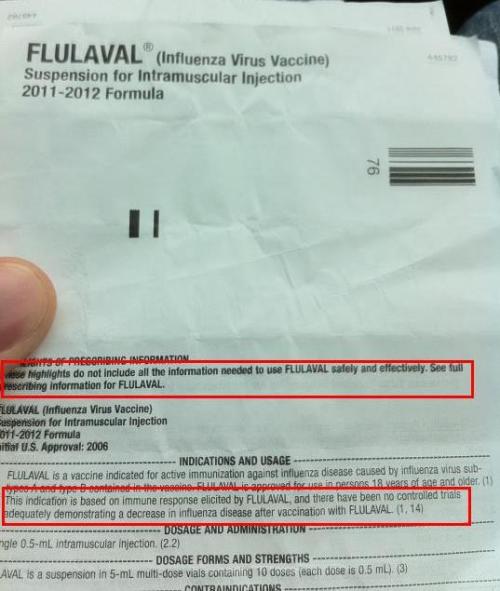
This indication is based on immune response elicited by FLULAVAL, and there have been no controlled trials adequately demonstrating a decrease in influenza disease after vaccination with FLULAVAL. (1, 14)[1]What this means is that the vaccine will generally give you the proper antibodies against the flu, but they have been unable to prove that it will decrease your risk of getting the flu. One should equal the other, but in medicine they have a greater burden of proof. In a trial, more people contracted the flu with the placebo than with the vaccine. Still they have not run the experiment to prove that you are less likely to get the flu or at least they have not put the experiment on the fold out.

Subscribe to:
Posts (Atom)