But the LORD selected you and brought you out of Egypt's iron furnace to be a people for His inheritance, as you are today." ~ Deuteronomy 4:20
I thought this was strange to mention iron furnaces during the Bronze Age, but it is cooler than that. By 3200 BC, Egypt had begun smelting iron meteorites, 2000 years before they figured out how to smelt native iron.
Showing posts with label meteor. Show all posts
Showing posts with label meteor. Show all posts
Sunday, March 23, 2014

Sunday, November 17, 2013
Is the fossil record complete?
A couple of years ago, someone gave me some magazines from the Institute
of Creation Research. I was amazed to
read that the fossil record was considered by creation science to be nearly
complete. Fossilization is a chance
process by which some of a creature is preserved by replacing organic matter
with rock. The general model assumes
that natural forces destroy most carcasses before they would even have a chance
to fossilize. The fossils that are
preserved are a small minority that survived until fossilization, during
fossilization, and after fossilization.
These fossils are accumulated over a billion years.
Obviously the creation model assumes that
fossilization is far more likely.
Instead of a billion years, the creation model advocates that all
fossils were formed in a matter of thousands of years. Fewer creatures lived and died and a much
larger proportion were preserved. However
were about 100% preserved? I would like
to propose a few reasons why I do not think the Creation model is completely
amicable to fossil formation.
Meteors
Then the third angel blew his trumpet, and a huge star burning like a torch fell from the sky; it landed on a third of the rivers and on the springs of water. 8:11 (Now the name of the star is Wormwood.) So a third of the waters became wormwood, and many people died from these waters because they were poisoned. ~ Revelation 8:10-11
 | ||||
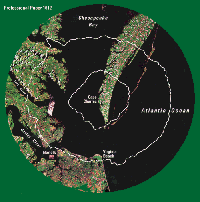
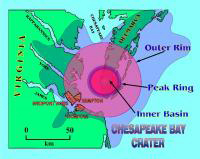
| The Chesapeake Bay Impact Crater |
There are about 178 known fossil craters buried in different
layers of strata.[Earth Impact Database] The Chesapeake Bay Impact Crater, the largest crater in the United States, is close to home. A meteor more than two miles wide slammed into the earth with more force than all the nuclear weapons on earth combined. The general model puts the impact at around 35 million years ago during the Eocene [Bolide] According to Creation Scientist John R. Baumgardner, PhD, the Eocene occurred after the Flood, so the meteor struck sometime four thousand years ago.
Answers in Genesis
proposes that all 178 or more collided with the earth mostly during the flood
year or close afterwards. Most of the
craters were buried in sediment at the level in the newly deposited geologic
column they struck. Therefore meteors
with the forces of atomic weapons collided with the earth at a basic rate of
one every few days. These impacts
would seem to me to destroy large amounts of fossils around the globe. [A Biblically-Based Cratering Theory]
Also another point about the meteors, Meteors follow
trajectories governed by gravity. These
meteors would have been destined to hit the Earth for millennia.
God saw all that he had made – and it was very good! There was evening, and there was morning, the sixth day. ~ Genesis 1:31
So God created the Solar System with swarms of
meteors that were going to hit the earth during the flood year. He called this “very good”. The flood seems almost like an act of mercy for
drowning the people before they could die in an apocalypse from the sky. During the tribulation only one meteor fell,
but the Flood event had over a hundred.
God clearly sent missiles with nuclear equivalent power to earth from
week one dedicated with wiping out mankind on an appointed date.
Water Velocities of Ocean Currents
Most creationists believe that Noah’s Flood both
deposited the sediments and then carved the terrain into canyons and
hills. So in order to deposit the
sediment, the flood first had to create or find the sediment. Considering that it is unlikely that a mile
of sediment was just lying around, in 1994, some researchers at the Institute
of Creation Research constructed a computer model that estimated the water
velocity of Noah’s Flood. According to
them the currents were moving at about 40-80 meters per second. Water at these speeds would erode large
amounts of rock and distribute it over extensive areas in the short amount of time
provided by the flood year. [Patterns of Ocean Circulation over the Continents during the Flood]
In 2010, scientists discovered the fastest ocean
current moving around Antarctica. They clocked it at 7.9 inches per second or 0.20066 meters per second. These creation scientists are postulating that the currents during Noah’s flood would have been 200 to 400 times faster than the currents today. These currents do not seem amicable to fossil preservation. Bones could have easily been washed away with skeletons separated from each other. I am not a geologist, but if these things are grinding up rock it does not seem like the carcasses have much of a chance. Anything that can do it to a rock …can likely do it to you. [Fastest Ocean Current Flows Beneath Antartica]
Tuesday, August 20, 2013
Was Peter talking about meteors or nuclear weapons?
"But the day of the Lord will come as a thief in the night; in the which the heavens shall pass away with a great noise, and the elements shall melt with fervent heat, the earth also and the works that are therein shall be burned up." (2 Peter 3:10)
When the atomic bomb burst over Hiroshima in 1945, the thoughts of Bible-believing Christians everywhere turned almost immediately to this verse. There was also widespread concern that man's newly discovered ability might get out of control and cause all "the elements to melt with fervent heat"! Seemingly, Peter had prophetically anticipated, 1,900 years in advance, the modern discovery of nuclear fission.
Super sonic meteor impacts melt the elements and predate atomic weapons. In fact, craters created by atomic weapons jump started the study of meteor craters. I visit the Chesapeake crater frequently which was created by a force greater than all the atomic weapons in the world combined. Why couldn't Peter have been talking about meteor impacts rather than puny atomic weapons?
http://www.icr.org/article/7508/?utm_source=dlvr.it&utm_medium=facebook
Thursday, January 26, 2012
Martian and Lunar Meteorite Primer
Stone Meteorites from Moon and Mars
Do we really find lunar and martian rocks on the surface of our own planet? The answer is yes, but they are extremely rare. About one hundred different lunar meteorites (lunaites) and approximately thirty Martian meteorites (SNCs) have been discovered on earth, and they all belong to the achondrite group. Impacts on the lunar and Martian surfaces by other meteorites fired fragments into space and some of those fragments eventually fell on earth. In financial terms lunar and Martian specimens are among the most valuable meteorites, often selling on the collectors' market for up to $1,000 per gram, making them worth many times their weight in gold. [1]
Small rocks on the surface of the Moon and in orbit around the Sun or Earth are exposed to cosmic rays. The cosmic rays are so energetic that they cause nuclear reactions in the meteoroids that change one nuclide (isotope) into another. Some of those nuclides produced are radioactive. As soon as they fall to Earth, production stops because the Earth's atmosphere absorbs nearly all cosmic rays. The radionuclides decay on Earth with no further production. The most well-know such isotope is 14C (carbon 14), which is produced from oxygen atoms in the meteoroid. Other important radionuclides produced by cosmic-ray exposure are 10Be, 26Al, 36Cl, and 41Ca. Because the various radionuclides all have different half-lives, it is often possible to tell how long a rock was exposed on or near the surface of the Moon, how long it took to travel to Earth, and how long ago it fell.
[2]


Tuesday, January 24, 2012
Martian Meteorites
 |
| A Mars meteorite stone (shergottite) weighing 452.6 grams. |
(AP) Updated: 1:05 PM: WASHINGTON - Scientists are confirming a recent and rare invasion from Mars: meteorite chunks from the red planet that fell in Morocco last July.
This is only the fifth time scientists have confirmed chemically Martian meteorites that people witnessed as they fell. The fireball was spotted in the sky six months ago, but the rocks were not discovered on the ground in North Africa until the end of December.
This is an important and unique opportunity for scientists trying to learn about Mars' potential for life. So far, no NASA or Russian spacecraft has returned bits of Mars, so the only Martian samples scientists can examine are those that come here in meteorite showers.
Scientists and collectors of meteorites are ecstatic, and already the rocks are fetching big money because they are among the rarest things on Earth, rarer even than gold. A special committee of meteorite experts, including some NASA scientists, confirmed the test results Tuesday. They certified that 15 pounds (7 kilograms) of meteorite recently collected came from Mars. The biggest rock weighs more than 2 pounds (1 kilogram). Astronomers think millions of years ago something big smashed into Mars and sent rocks hurtling through the solar system. After a long journey through space, one of those rocks plunged through Earth's atmosphere, splitting into smaller pieces.
Most other Martian meteorite samples sat around on Earth for millions of years, or at the very least for decades, before they were discovered, which makes them tainted with Earth materials and life. These new rocks, while still probably contaminated because they have been on Earth for months, are purer.
The last time a Martian meteorite fell and was found fresh was in 1962. All the known Martian rocks on Earth add up to less than 240 pounds (110 kilograms). The new samples were scooped up by dealers from those who found them. Even before the official certification, scientists at NASA, museums and universities scrambled to buy or trade these meteorites.
"It's a free sample from Mars. That's what these are, except you have to pay the dealers for it," said University of Alberta meteorite expert Chris Herd, who heads the committee that certified the discovery.
He already has bought a chunk of meteorite and said he was thrilled just to hold it, calling the rock "really spectacular." One of the crucial decisions the scientists made Tuesday was to connect these rocks officially to the fiery plunge witnessed by people and captured on video last summer. The announcement and the naming of these meteorites - called Tissint - came from the International Society for Meteoritics and Planetary Science, which is the official group of 950 scientists that confirms and names meteorites.
Scientifically invaluable"
Meteorite dealer Darryl Pitt, who sold a chunk to Herd, said he charges $11,000 to $22,500 an ounce and has sold most of his supply already. At that price, the new Martian rock costs about 10 times more than gold.
"It's scientifically invaluable," Herd said. "These are really beautiful specimens. It's a rare type, so fresh and aesthetically pleasing."
Several of the world's top experts in meteorites, including those who work for NASA, told The Associated Press that they were sure this was a piece of Mars. Tony Irving of the University of Washington is the scientist who did the scientific analysis on the rocks and said there is no doubt that they are from the red planet. Scientists can tell when meteorites are from Mars because they know what the Martian atmosphere is made of, thanks to numerous probes sent there. The chemical signature of the rocks and the Martian air match, Irving said. Another clue is that because planets like Mars are more geologically active, its rocks tend to be much younger - millions of years old instead of hundreds of millions or more - than those from the moon or asteroids.
Most of the Martian rocks on Earth have been around for centuries or longer and have been found in Antarctica or the desert. They look so similar to dark Earth rocks that if they fell in other places, such as Maryland, they would blend right in and never be discovered, Irving said.
Jeff Grossman, a NASA scientist who is the Meteoritical Society's database editor, said there is a higher probability of finding "something interesting" from Mars on these rocks because they fell so recently. However, six months is a long time for Earthly contamination to take root, he said.
Herd said the first thing he would do with the rocks would be to rinse them with solvents to try to get rid of earthly contamination and see what carbon-based compounds are left.
A Martian meteorite that was buried in Antarctica made news in 1996. NASA scientists theorized that the rock, found in 1984, showed signs of traces of life from Mars, fossils of what seemed to be lifelong forms. Even the White House made an announcement about it as the first sign of life outside of Earth. Years of study since then have led much of the astronomy world to conclude that there was not enough evidence to support the claim.
Because known Martian meteorite falls happen only once every 50 years or so - 1815 in France, 1865 in India, 1911 in Egypt and 1962 in Nigeria - this is a once-in-a-career or even one-in-a-lifetime event.
"It's incredibly fresh. It's highly valuable for that reason," said Carl Agee, director of the Institute of Meteoritics and curator at the University of New Mexico. "For someone who knows their Martian, this is a beauty. It's gorgeous." [2]
Subscribe to:
Posts (Atom)